
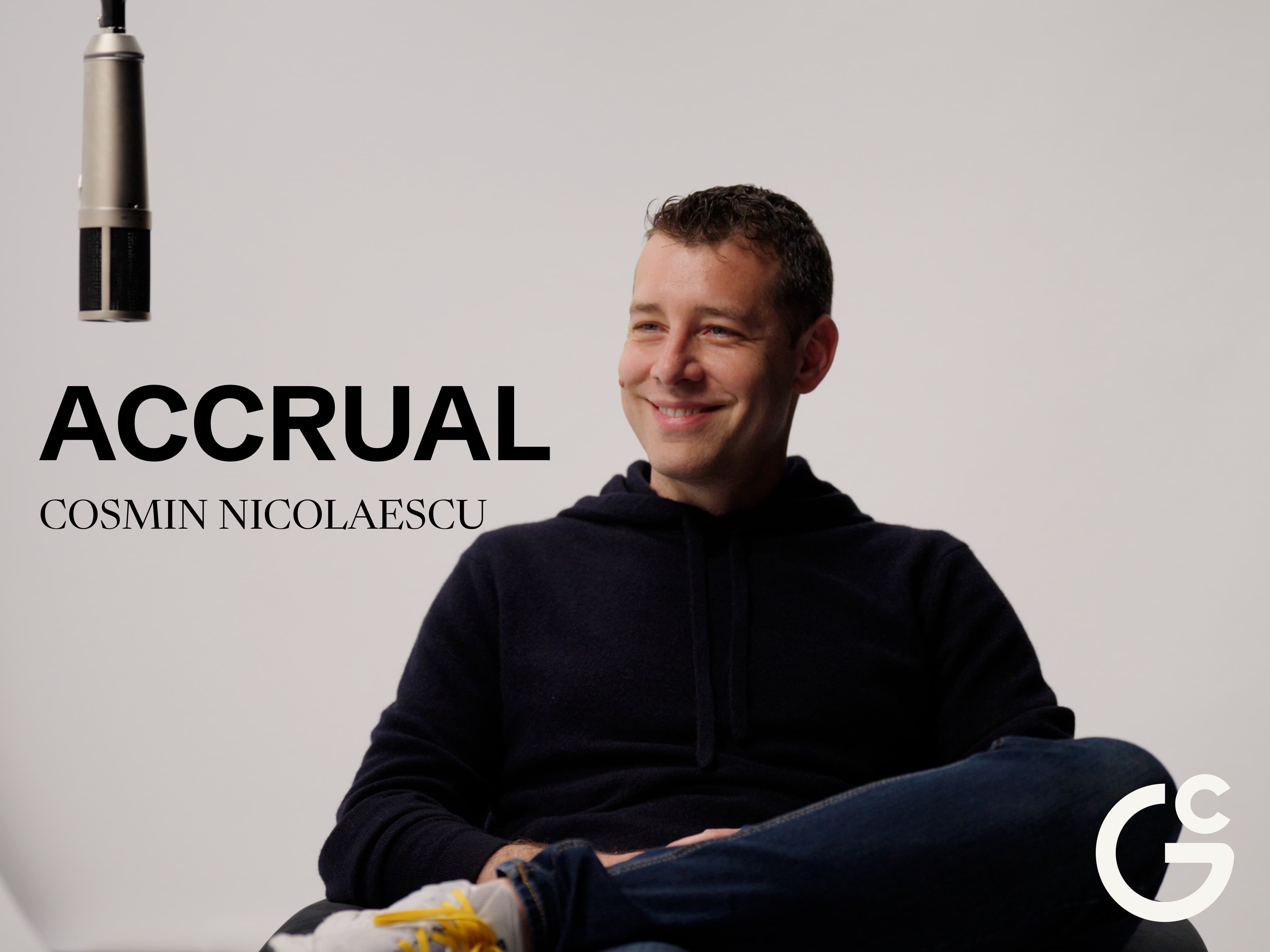
General Catalyst’s Marc Bhargava sits down with Accrual co-founder and CEO Cosmin Nicolaescu, the former Brex CTO who spent years saying he didn’t want to be a founder before starting Accrual alongside his best friend from Stripe, Sidd Chandrasekaran. They first went after tax prep’s biggest bottleneck: manual document processing. Accrual has since grown into one platform across tax, audit, and advisory.
This interview has been edited and condensed. Watch the full video below.
Marc: Tell me about your background. Where did the entrepreneurial streak come from?
Cosmin: I grew up in Romania and got into computers because of my older brother. In high school, I wanted to learn about networks, and the school said no. So I broke the school's network, and they said, okay, maybe you should help us. My parents told me I could study in the U.S. only if I got a scholarship. I did, moved at 18, studied computer science, and joined Microsoft, where I worked on Azure and Office 365. Then I went smaller and joined Stripe at about 100 people, leading the teams that move money across payment rails worldwide. That's where I met my co-founder, Sidd. We were on the same team together and became best friends. After a few years at Stripe, I joined Brex as CTO when it was 30 or 40 people. People would ask if I wanted to be a founder, and I'd say no. I loved operating. But in my last couple of years at Brex, I got close enough to the founders and investors to form strong opinions about how to build a company. The only thing I hadn't done was build one.
Marc: What did you take from Stripe and Brex?
Cosmin: Patrick and John at Stripe have a superpower. They're optimistic about the long term and pragmatic about the short term. People would list reasons an idea wouldn't work, and they'd say, "But what if it does? Let's try it." Some of those became huge businesses. Stripe also taught me the difference between shipping separate products and building a platform where every surface works together. At Brex, I got much closer to running the business, from go-to-market, to the shift from small business to enterprise, and what that costs the organization and the customer.
Patrick and John at Stripe have a superpower. They're optimistic about the long term and pragmatic about the short term.
Marc: Why accounting?
Cosmin: We had a few rules. Enjoy the technical problems and the customers, or you burn out. We wanted to pick a business where the hardest pieces are engineering-solvable, because that's what we're good at. We also wanted to enjoy the technical problems and customers to avoid burnout. And the business had to use both complex workflows and AI. If you're just an AI wrapper, the models will get better and move into your space. If it has nothing to do with AI, why do it now? Accounting is really complex work, not a single-player thing you can one-shot, and AI lends itself to it if you architect things the right way. When we met GC, you pushed us past "we save accountants some hours" to "how do you change the industry over the next ten years?"
Marc: We'd met 50 or 60 teams in the space, and you were the only ones describing a platform instead of a point solution. With that much surface area, where did you start?
Cosmin: Tax services. Almost every firm does it, it's both client-facing and preparer-facing, and it forces you to build a lot of the core mechanics of the platform. Tax also has an enormous range of complexity. To serve a partnership, a firm also does the partners' returns, then their families'. So we picked two extremes as our first customers. H&R Block has simple returns at huge volume. Armanino works with some of the wealthiest Americans and family offices. Building for both gave us the foundational blocks.
Marc: GC is a big investor in Anthropic. What do you say to people who think the labs will just do accounting themselves?
Cosmin: The labs already earn a lot from companies like us building on top of them. Where they've gone direct are in single-player tasks, like drafting an email or writing code. Accounting is multiplayer. Different people have to coordinate, so you need a product built around the workflow. And it's not one shot. Even a simple individual return gets documents in February, March, April, and the fall, with back-and-forth throughout and a human in the loop. Individual steps can be one-shotted but the overall workflow won't be anytime soon.
Accounting is really complex work, not a single-player thing you can one-shot, and AI lends itself to it if you architect things the right way.
Marc: What can you build now that you couldn't before AI?
Cosmin: It starts with the client. Drop in any document, structured or not, annotated or consolidated, and it gets sorted. Before, OCR handled known formats and humans did the rest. Then it's understanding the contents. You upload a W-2, so you have this employer and these benefits, which might correlate with a K-1, whose footnotes we can trace and reconcile. And because complex returns won't be 100% automated anytime soon, we automate 90, 95, 99% of preparation and give the strongest signal about where a preparer should spend their time, so eventually they trust the system enough not to review everything else.
Marc: How much have the models changed over the last year and a half, and how has that shown up in the product?
Cosmin: Internally, for building our own software, we saw a huge jump last fall with Opus 4.5, and huge strides since then. On the product side, we started out model-agnostic, so we could flip a model with one line of code. It's not that simple. About 90% of what the general-purpose models do overlaps, but they spike in different ways, and even within that 90%, prompting and structured outputs differ. So we built strong evals across the product. For each new agent, we test the models and pick the best one for that problem, and those choices tend to stick. We try to stay on the latest models from every provider.
Marc: In under two years, you've signed some of the largest accounting firms in the world. How do you get a traditional industry comfortable with AI?
Cosmin: Accounting wants AI. It’s the main topic at every conference I go to. Firms just don’t know how to embrace it yet. But the industry has been over-promised and oversold for years, so first, we address the fears about where the models are used, data privacy, hallucinations, and reliability. The biggest challenge isn't technology, it's change management. My biggest fear from day one has been building really good software that doesn't land because we didn't help firms adopt it fast enough and deep enough. So we go deep on their standard operating procedures. The question isn't how to move a manual step into Accrual. It's whether we can delete that step entirely. And people who aren't on the bleeding edge don't want to feel stupid. Change is an emotional reaction, so we make it easy to ask questions.
My biggest fear from day one has been building really good software that doesn't land because we didn't help firms adopt it fast enough and deep enough.
Marc: You're also buying an accounting firm. Why?
Cosmin: It started from fear that we couldn't learn fast enough without owning a firm. That turned out to be wrong: our partner firms have been exceptional. But the most valuable thing a firm has is its partners' relationships, built over decades. Today advisory teams implement NetSuite or Workday. Tomorrow they'll implement AI. That requires a different culture and a different business model, and as a software vendor, I can drive efficiency, but I can't change how a firm operates. Owning one lets us be at the front of that shift. Stripe and Brex transformed their industries organically, but accounting has structural barriers that make building a top firm from scratch nearly impossible.
Marc: How have you built the team?
Cosmin: We picked a business that doesn't need to scale headcount fast. We're 20 people about a year and a half in, roughly half engineers. Hiring one person a month means we can do paid two-day work trials with anyone we haven't worked with, including dinner with the team, and we can hire mostly through our Stripe and Brex networks. For any new function, Sidd or I do the job first so we know what to hire for. We have no management layer. Everyone technically reports to me, but there are no one-on-ones and no internal meetings except company planning every two to three weeks. If you'd turn around and ask the question in an office, don't schedule a meeting. And when we meet up in SF or LA, people stay at each other's houses instead of hotels.
Marc: What surprised you most?
Cosmin: Everyone tells you there are ups and downs. I didn't appreciate how fast they come. Within a single day, I can feel like we have no shot and like we're going to do something amazing. And now I'm hiring roles I've never hired before. We have CPAs with decades of experience working next to engineers on the latest models. Getting that blend between a professional services firm and a technology company right is something I didn't have to think about a year ago.