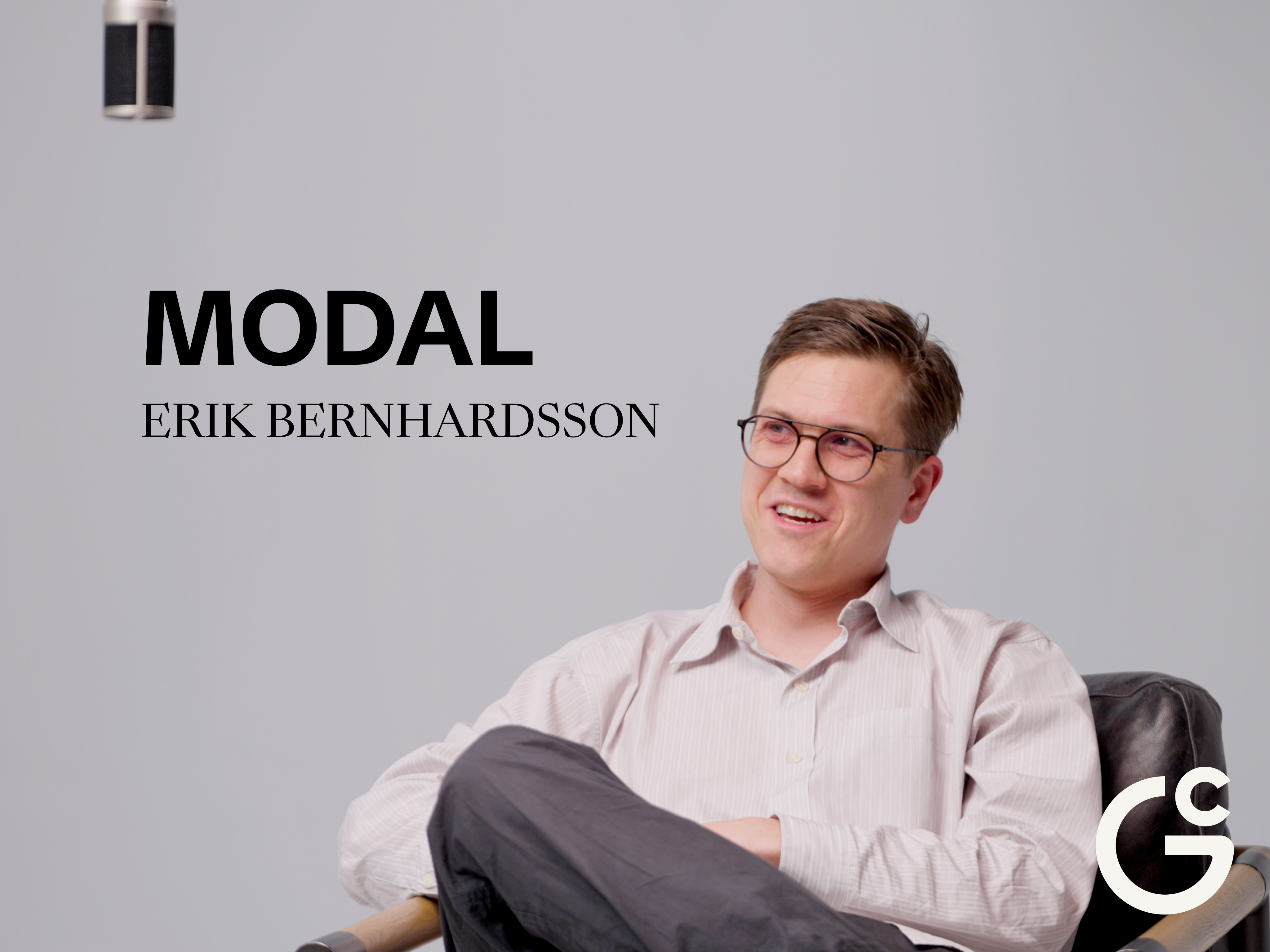
General Catalyst's Max Rimpel sits down with Modal's Erik Bernhardsson to talk about the ambition for a new cloud, solving compute-intensive problems, and building before product-market fit.
This interview has been edited and condensed. Watch the full video below.
Max: You taught yourself to code at a very young age. What anchored that passion?
Erik: My parents bought a Mac Plus. It had one megabyte of RAM, and it came with this multimedia thing called HyperCard, sort of like Visual Basic for Mac. I realized you could write your own scripts. It's funny because I didn't even know English. I learned a lot of English through code. It was just a little thing I discovered I enjoyed doing.
I learned a lot of English through code.
Max: This era's outlier companies are started by a disproportionate share of competitive programmers. Why?
Erik: When I think back at startups 10 or 20 years ago, the founders tended to be more businessy, a guy in a suit who would hire a bunch of engineers. In the last 10 years, it's the engineers on top, and they hire the people in suits. Now the engineer gets to run the company. There's more of an appreciation for technical founders, and I think that's a big shift.
Max: You joined Spotify as a tiny team and built the recommender system. How does that era shape you to this day?
Erik: The only reason I joined Spotify was that they were smart, and I wanted to work with smart people. Spotify was weird because it clearly had product-market fit, but not business-model fit. Everyone loved the product, but everyone said, "This is never going to work. You're going to get sued by the labels."
People just gave me a computer and said, "Figure out how to add value." I spent two years building a music recommendation system according to what I felt would be useful, and it turned out to be quite useful for Spotify. So that, to me, was the lesson: hire smart people and give them a lot of freedom.
Max: Is that where your obsession with the product experience came from?
Erik: With Spotify, the first experience with the product is magical.You download it, you double-click a track, and it's just streaming. It feels local, but it's in the cloud. It's about creating this magic moment, and doing that very early. That's something I took with me to Modal, because we've always been obsessed with developer experience. I just want people to install the Python library and run some code, and feel that magic in the first session. If you get them to feel like "oh, I'm in control," that's very powerful.
It's about creating this magic moment, and doing that very early. That's something I took with me to Modal, because we've always been obsessed with developer experience.
Max: When you came up with the idea for Modal, a lot of people said, "You're insane, just use Kubernetes." What gave you the conviction to rebuild the core infrastructure primitives?
Erik: If you're building infrastructure, you need to solve the infrastructure problems. And honestly, if you're not tackling hard problems, why are you creating a startup? I think the ultimate startup should take about one to two years to build something hard. If it only takes two months, anyone can copy it, and you don't have a lot of defensibility. If it takes five years, it's probably too hard, and what seems like five years is probably actually 25 years. You need to pick something sufficiently hard that you have durability, but not so hard that it's impossible.
Building our own file system, our own container runtime, all these things: they're hard, but actually not quite as hard as people think. Those are exactly the types of problems that attract me. Things you can do, but other people think are hard.
Max: You and Akshat had only spoken a handful of times before he quit Scale, moved across the country, and joined Modal. What gave you the conviction he was the guy?
Erik: In hindsight, it was a bad process, good outcome. I don't think you should ever pick a co-founder you just met. You should probably deeply know them. I didn't. But if you meet Akshat, he's just one of these incredibly smart people, probably the smartest person I've ever met. That did stand out. Still, at the end of the day, it was a leap of faith. But it worked out.
Max: People look at a company and think it's a straight line up. In 2022 the market turned, and there wasn't much pull yet. What kept you going?
Erik: It was pretty hard. We were a year and a half in. The market had just collapsed, and we had barely any revenue. Personally, I was basically broke, because I had self-funded Modal for a long time and wasn't taking a salary. It was very bad, both personally and business-wise.
Then two major things happened in fall of 2022: ChatGPT and Stable Diffusion came out. Stable Diffusion was a strong product-market fit for us. In September 2022, we had about $100 of revenue. October, $1,000 of revenue. November, $5,000 of revenue. That's when I finally realized maybe we have something here. In January 2023, we suddenly had $30,000 of revenue. Seeing that was such an amazing relief. If that hadn't happened, I don't know what we would have done. But we made it to the other side.
Max: Which taught you more, the search for product-market fit or having it?
Erik: Fundamentally, the product was never meant to be just AI or machine learning. We were focused on anything related to compute-intensive problems, and we happened to see product-market fit in one particular place, which was Gen AI inference. But over time—and this is one of the things I'm proud of—we've gone back to the original vision of building a very general-purpose platform. We now see product-market fit with sandboxes and batch jobs and training. It wasn't quite the path we projected, but we ended up in the same place we envisioned when we started Modal.
We now see product-market fit with sandboxes and batch jobs and training.
Max: I heard the Mage launch was one of the most intense periods for the company.
Erik: That was our first major customer, early 2023. When they moved most of their traffic to Modal, I was so paranoid. I set an alarm for after 1 a.m., and I didn't even need it, because I just kept waking up every hour, checking their GPU utilization. Overnight we went from almost no revenue to $50,000 a month. It wasn't until we had two or three major customers that I finally felt like, okay, now I can relax a little bit.
Max: How would you explain Modal to your mom?
Erik: We do AI infrastructure. There are a lot of very cool companies that build incredible AI applications, and they don't necessarily want to deal with infrastructure. What they're good at is training models, or building a consumer app. Building infrastructure gets in the way of iterating quickly. We solve that problem.
The goal has always been to almost become a new cloud, purpose-built for compute-intensive applications. The existing cloud solutions were just not meant for these workloads: working with large models, working with GPUs, iterating quickly. So the somewhat megalomaniac vision we've always had is to build a new cloud, with primitives that help other people build AI applications while we build the underlying infrastructure.
Max: What's the role of taste in building products, and what's the future of developer experience when more code gets written by agents?
Erik: Taste gets overused sometimes, but it's about having a high bar for everything, consistently. At Spotify we were very obsessed. It shouldn't take 300 milliseconds when you double-click a track, it should take 100. Every millisecond counted. It's a lot of small details that add up.
With developer experience, a lot of it comes down to a super fast feedback loop. Many of our earliest decisions, building our own file system and scheduler, were all meant to serve great developer experience. It turned out to be really good for online inference too, but developer experience was the core thing.
And now agents. We discuss this a lot internally: how do you optimize for agents? I feel like it's the same. The models are trained on humans, so if you deliver a good developer experience, you probably also deliver a good agent experience. What agents like are descriptive error messages, descriptive method signatures, fast feedback loops. All the same things as humans. They're worse at dealing with API deprecations, so you need a more stable API. But generally, it's roughly the same thing.
The models are trained on humans, so if you deliver a good developer experience, you probably also deliver a good agent experience.
Max: A lot of your peers are buying up GPUs and data centers, but you've stayed the course. Where does value ultimately accrue?
Erik: Being a neocloud has been a very good business in the last five, ten years, but I don't think these businesses are that differentiated long-term. As the infrastructure becomes more of a commodity, the value accrues in the layer above, especially as we build a thicker and thicker differentiating layer. For that reason, I'm not a GPU hoarder. As I think about building a capital-efficient business, there's a lot of value in staying out of owning hard assets. But I'm not dogmatic about it. I wouldn't rule out buying GPUs; it's just not particularly appealing to me.
Max: You've done thousands of candidate interviews. What signal is still hardest to read?
Erik: Everything is hard to predict, but intelligence is easier, and commercial instincts are somewhat easier on a relative basis. The hardest thing to pick up is: will they work hard? You don't know. You might hire someone who's incredibly smart, who says all the right things, and then they come in and they're just kind of lazy. That's the one thing where you have to go by references a little bit more.
Max: I'm told founders need hobbies, or at least micro hobbies. Yours involves chili peppers?
Erik: I basically don't have time for hobbies, so I've been looking for what I call micro hobbies, things I can spend 20 hours a year on just because I like it. During the pandemic I started growing chili peppers on my terrace in New York, mostly habaneros and ghost peppers, because the harvest is meager so you might as well grow as strong as you can. Then I started making sauce and got into fermentation. I have a bunch of hot sauce at home if you want. I'll bring some bottles.
Max: Last one: Anything you wish you knew when you started Modal?
Erik: I didn't know much about B2B. My whole experience was direct-to-consumer, so I've had to learn a lot about enterprise sales.
Max: Seems like you're doing just fine.
Erik: Trying!
%201.svg)