General Catalyst's Paul Kwan sits down with Cameron McCord to unpack the founding insight behind Nominal, what it means to bring physical AI into the real world, and why global resilience is ultimately a hardware problem.
This interview has been edited and condensed. Watch the full video below.
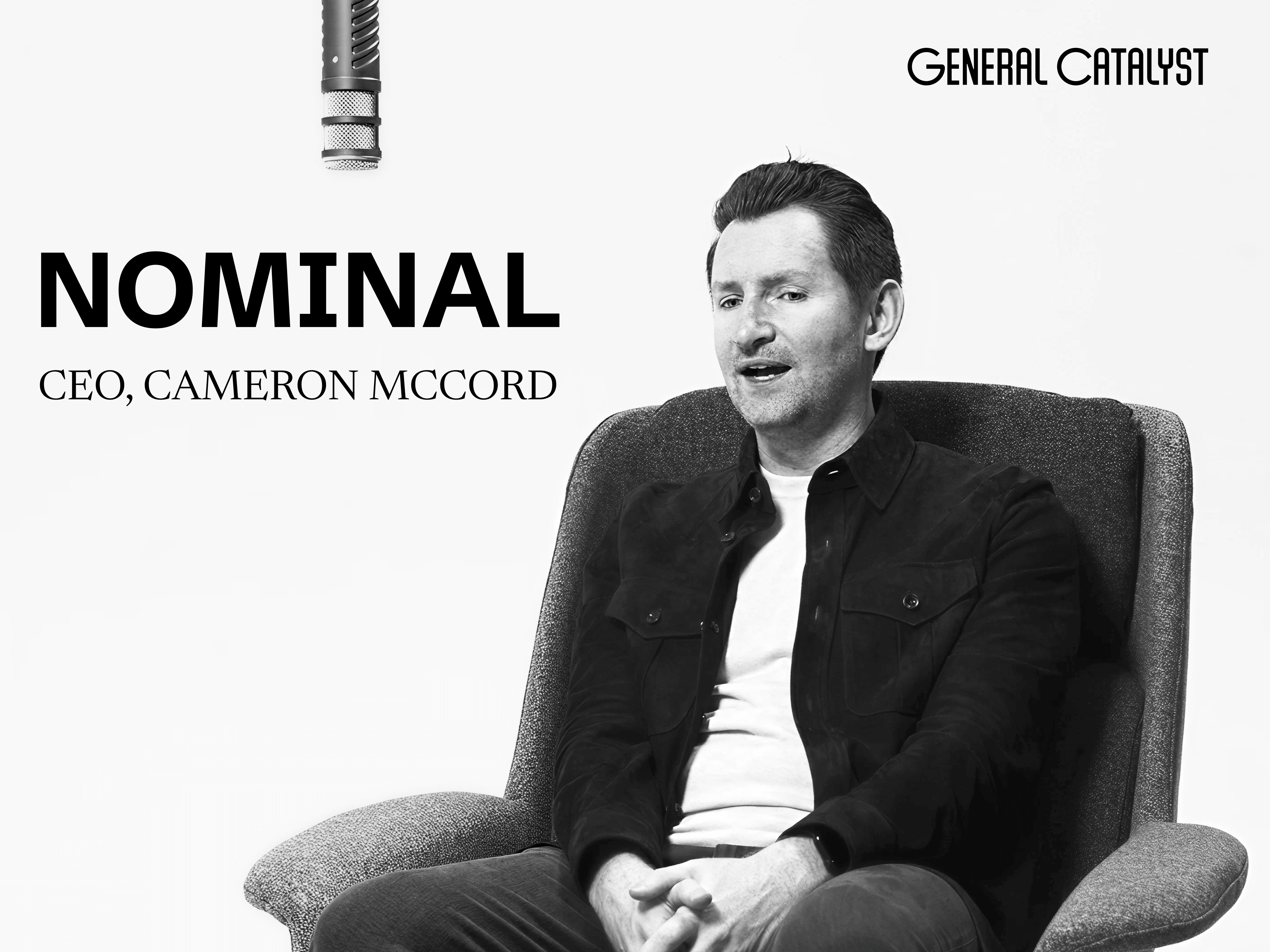
Paul Kwan: So Cameron, you come from a long line of naval officers. You served and were deployed globally. Talk about how that global experience has informed what you're building at Nominal.
Cameron McCord: I grew up in a really large Navy family. I ultimately decided to serve. I spent 484 days underwater on a submarine. We did a lot of joint exercises with foreign countries, foreign navies, and NATO allies. And then later in the Navy, I had the really unique opportunity to serve in legislative affairs. So I actually worked on Capitol Hill. And when I was doing that, I had one major takeaway: the ability to produce hardware at speed and at relevance is something that's really important for the entire world.
Paul Kwan: Can you tell me about the pivotal moment that your vision for Nominal came together?
Cameron McCord: I think that insight for me actually happened at another General Catalyst company, Anduril. In the early days of Anduril, I was part of the rag-tag group of people that were testing, validating and producing Anduril’s Counter Unmanned Aerial Systems (C-UAS) and their anti-drone system.
What that looked like, even with the best software available in 2019, was early mornings. It looked like driving out to Apple Valley, California, to the desert, sitting in a trailer and trying to bend those old software tools to your will to be able to move fast, iterate quickly, test and validate.
When I was on a submarine, I had 1970s technology. So I think one theme there is just being familiar with relying on old software for life or death, mission critical applications and wanting to change that.
I also worked at another company, Saildrone, building an autonomous robotic boat. There, I experienced yet another flavor of that challenge. So much effort goes into demonstrating new defense technology but we only capture a fraction of the data those experiments generate. And on top of that, it’s hard to derive insights from that data.
Paul Kwan: So there’s this phrase, for those that aren’t familiar with the defense aerospace market: “all systems nominal.” Talk about how that’s become a North Star for your business as you help hardware defense aerospace companies build.
Cameron McCord: “All systems nominal” means everything is satisfactory, all checks have passed. If you’re ever watched a SpaceX launch video, you’ll hear them say “all systems nominal” multiple times. It’s our slogan. To this day, we still send a little video that says “all systems nominal” to every new employee at the company.
Paul Kwan: Who are some of the customers that you're working with at Nominal now?
Cameron McCord: We're proud to serve over 60 commercial customers. We're working with four of the five largest traditional defense primes. We work with companies like Anduril, we work with the Corvette racing team. So, beyond just defense we are fully operating in all domains. We work with unmanned underwater vehicle (UUV) submersible companies like Vatn Systems. We work with companies operating on land like Chariot Defense building next generation power systems for the army, aerial companies like Hermeus, and even in space, companies like Albedo.
Paul Kwan: At General Catalyst, we talk a lot about global resilience. Where do you see Nominal headed vis-à-vis that opportunity?
Cameron McCord: I think this is so much bigger than just America. This is truly a global challenge and a global opportunity. Late last year, we opened our office in London and we're expanding quickly in the UK and in the EU. You don’t have to look far to understand that with a global land conflict in Europe still persisting in 2026, there is a huge demand for the innovation Nominal offers.
For two decades, the world optimized for software and SaaS. Now we're having a reckoning—and Nominal is core infrastructure for that shift, a tool that helps people realize their hardware ambitions.
Paul Kwan: You've done a lot in the last three and a half years, but let's go forward three and a half years. What does Nominal look like in the future?
Cameron McCord: We’ve started with hardware testing. I think that’s the area where software-defined hardware systems meet reality. It’s the first time these systems are actually operated in the physical world, so it’s really the frontier of where AI meets the physical that you have to solve testing. We’re really excited to lean into more of that frontier.
We think of Nominal as a key system of record in understanding the unit testing level of hardware, a core building block in actually being able to build more automation. Things we’re already powering right now, such as plotting the kinematics of a drone, rely on the ability of engineers to prompt and interact with the Nominal platform through an LLM interface to perform hardware testing.
It used to take 50 engineers to test one physical system, in the future we will have a 1:1 ratio. What does it look like for one engineer to be able to test 50 hardware systems?
Paul Kwan: Before we invested, you came to our office and it felt more like you were interviewing us than the other way around. You wanted to understand how we think about scaling and building a compounding, generational company. And now I wanted to turn that question on you, what makes Nominal generational?
Cameron McCord: Yeah, I remember that meeting and dual interview, if you will. Intentionality and compounding advantage have been major themes in my life. And so I look at Nominal as the amazing culmination of my time spent in the service operating hardware, and my experience with the legislative branch, into my experience at companies like Anduril. I’m pulling that all together to take a big swing with Nominal.
I remember something you said, Paul, which is that companies are built in big phases. Nominal has had a successful phase one but my job as a founder and CEO is to always be thinking about Nominal’s next act. And I need to give people enough data to understand what that journey is going to look like.
I think that is one of the biggest competitive advantages that Nominal has in the talent market right now, especially amid a lot of AI hype. I still interview every candidate at Nominal and it will be a sad day when that isn’t scalable anymore, but that day is not today.
When I ask people, Why Nominal? What’s got your attention? There are always a lot of reasons, but unilaterally people mention the mission. People are using our software for flight testing with human beings involved, so the system has to work. That mission critical mentality is everywhere in our ethos.
We have an office in downtown Manhattan and it’s been really interesting the number of candidates coming to Nominal from within New York City saying, I didn’t realize there was a company here that would let me work with an aerospace company, a fusion reactor, a submarine, a medical device robot and someone building next gen desalination purification all in one week!
Paul Kwan: If you look across category-defining tech companies over the last 25 years, they all share two things. One is the ability to think in chapters, a vision for how the company story evolves, and they're actively building toward it. At the same time, they have an almost paradoxical attention to detail in the weeds. The way you talked about Nominal early on had both: the intentionality around product discovery, culture, hiring, compensation, product design—all of it. That detail, coupled with a compounding vision, is the secret sauce.
%201.svg)