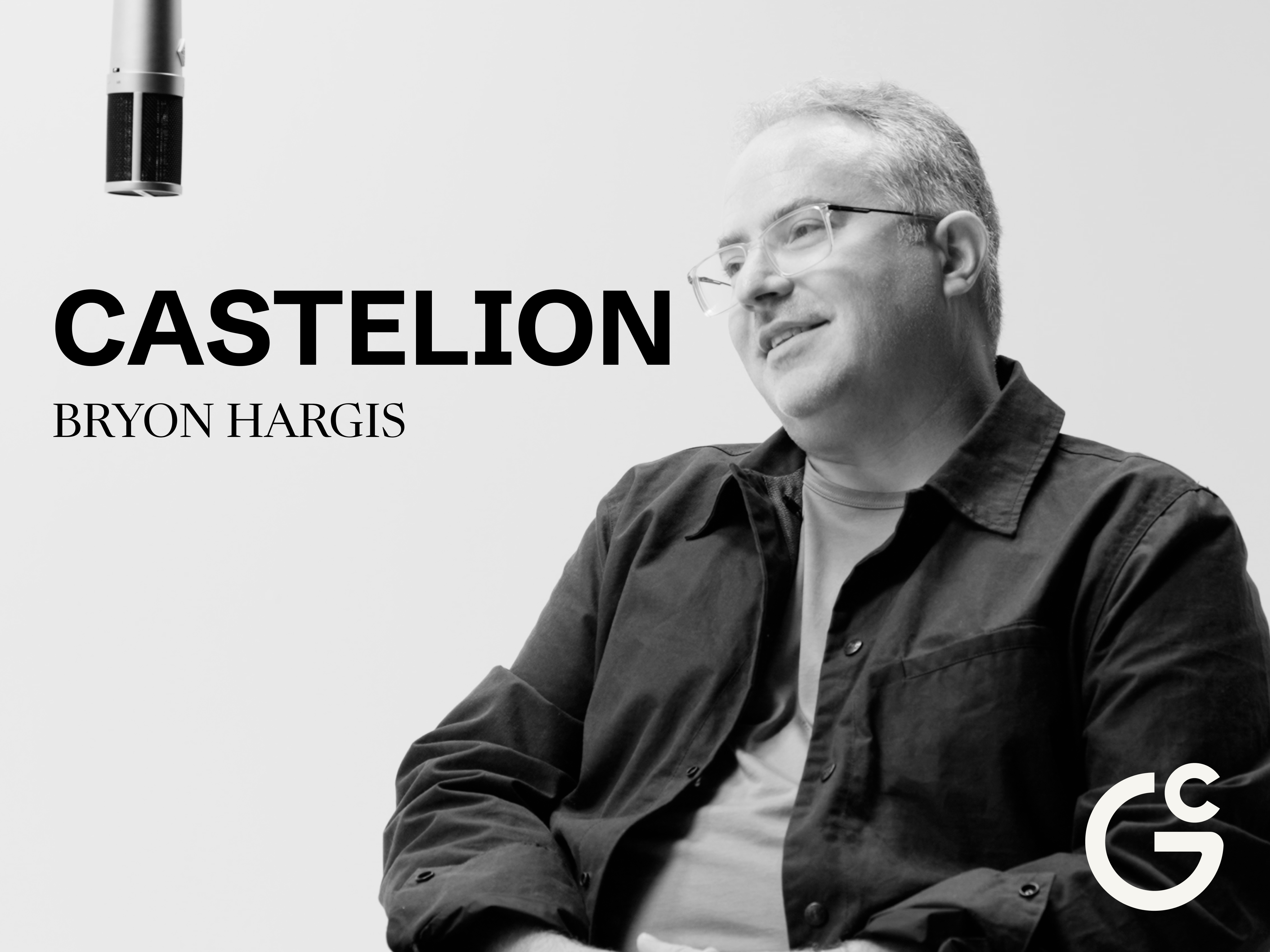
General Catalyst's Alexa Liautaud sits down with Castelion founder Bryon Hargis to discuss why solving cost and scale is the key to keeping America safe, how lessons from SpaceX are reshaping defense manufacturing, and why the cost of hypersonic missiles is breaking American deterrence.
This interview has been edited and condensed. Watch the full video below.
Alexa: Let's go all the way back. Where did your interest in aerospace start?
Bryon: Straight out of Georgia Tech I had a few paths in front of me: finance, oil and gas, or aerospace. Finance had a lot of money, but it was clear anybody there would stab you in the neck to make a little more, which didn't fit my personality. Oil and gas meant two years in Nigeria, two years on a North Sea rig, then Houston as the reward. Then I interviewed at Johns Hopkins Applied Physics Lab. They showed me this incredible optics lab, lenses and lasers and cameras everywhere, and then told me they couldn't tell me what they were working on. So I thought, clearly, this is the career choice. I spent years in that lab building things.
Alexa: Did you know then you'd start your own company?
Bryon: Absolutely not. I wish I'd had more entrepreneurial spirit in my family, but I didn't. I ran a lawn care business through high school and had more liquid cash than almost anyone I knew, but I didn't know anything about running a business. You went to school, got a job, worked for someone else your whole career. Reading about people who started companies, it seemed so foreign, so impossible. Some founders leave college and immediately start something. I never would have had the confidence. I had to take the hard path, which is a good analog for everything I've done. It turns out I could have built a business putting happy faces on sponges, but instead it's, no, we're going to build a hypersonic missile.
Alexa: When did SpaceX come into the picture?
Bryon: I went into traditional aerospace in 2002, right around when SpaceX was formed, so you knew of them, and people talked about them negatively. "What a bunch of yahoos, they don't know what they're doing." Which is generally how they treated anyone out of school: you learned a certain way, then they beat it out of you as not the correct aerospace way. But I watched what SpaceX was achieving, and you could hear this cognitive dissonance of people saying they're doing it wrong while it looked like they were doing it right. When they announced reuse, another wave of people said it's impossible, and it's like, well, it seems possible if you try. I was locked in a cube at The Aerospace Corporation in El Segundo, reading about companies launching satellites, thinking, what am I doing here? I want to go build.
Alexa: But you didn't go straight to SpaceX.
Bryon: No. I joined some friends building an AI company in the mid-2010s, back when we were actually made fun of for doing AI. Leaving The Johns Hopkins University Applied Physics Lab was terrifying. I'd been there 12 years. It was so safe I could have retired from it. I remember being so nervous, like I'm going to throw away 12 years. Looking back, that fear doesn't even make sense to me anymore. If you start something and it doesn't work out, you get promoted, you get a better job, you can probably go right back. The company sold to Vista Equity, and then I wanted back into aerospace. I looked around at who was making it happen, and it was obviously SpaceX. I didn't know anyone there, so I applied blind. I had two resumes, a boring black-and-white one and a creative one with a photo, and figured they were a creative company, so I sent the creative one. I got relentlessly made fun of for it for my entire time there, but I got picked out of hundreds of resumes.
Alexa: And you got the job.
Bryon: After about eight interview rounds, which is more than I ever put people through. Somewhere around interview five I'd accepted I was never getting hired. Then they offered me a position a level below what I'd applied for, which was gut-wrenching, and I thought about not taking it. A good friend said, "What are you doing? Just go do it." Great advice. So I went in and did my best, and my best turned out to be a lot. I built out the Starshield program and worked on getting mobility into Starlink, which wasn't originally going to have it. That caused tremendous friction with engineering because it added complexity, but in government you don't want fixed satellite communications, you can just trench fiber to a building. You want it mobile. We did demos with the Air Force that were tremendously successful, both financially for SpaceX and as a capability for the country.
Alexa: You built that business out from scratch. Why leave?
Bryon: In the early days it was just me, paired with one engineer who'd tolerate my questions, with full authority to set the direction, and it came together in a way I'm still incredibly proud of, a capability the country had talked about needing for decades but nobody had done, because it was going to cost too much and take too long. But it was always about the outcome. As we solved the things most aligned with the SpaceX mission, we moved toward getting to Mars, and Elon never hid that making humanity multi-planetary was his primary goal. I cared about deterrence. After asking whether SpaceX would take those next steps and getting a no, it became obvious I should leave and do it myself. Early on at Castelion, honestly, it felt like I quit to become unemployed.
Alexa: What is Castelion?
Bryon: We built the company to help the country achieve overmatch in non-nuclear deterrence. The way the aerospace industry has gone after defense manufacturing for decades has produced results that are overpriced and behind schedule. That was fine when America was ahead by far, but that's not the case anymore, and others are catching up. So we formed the company to bring advanced hypersonic weapons at scale, affordably, to achieve deterrence. I completely believe in peace through strength. It keeps you safe if someone knows that if they mess with America, it's going to be a bad day. Right now, in certain scenarios, we're losing the ability to project force back. I have two small children, and I want to leave them as safe a world as I had the benefit of growing up in. That's maybe an awkward thing for someone who builds munitions to say, but I wish the world were a place where we all just got along. I don't think that's realistic, and in a world where it isn't, the best outcome is that America has unapologetic strength.
The best outcome is that America has unapologetic strength.
Alexa: What makes hypersonics such a deterrent?
Bryon: It's the combination of three things: they go fast, they go far, and they're survivable, meaning the weapon survives to the target. Our adversaries have known for decades that we have great weapons like Tomahawks, so they put their systems on mobile platforms. If you want to reach a target, you have to get there quickly, before they drive it off. Hypersonics fly at very high altitude with low aerodynamic drag, and between the altitude and the speed they're very hard to hit. That combination makes it the perfect deterrent.
Alexa: Why now?
Bryon: The problem has been self-evident for a long time. What's changed is the environment. Defense wasn't hot in 2022, it was horrific trying to raise our initial funds, but the problem itself was obvious. My advice to founders is that you don't need a gimmick or something clever. Pick a problem that is so blatantly obvious you feel you could contribute to it, and go solve it at scale, and everything will fall into place. America actually started working on hypersonics first, and has for decades, with test flights that work great. What we never solved was cost and scale. These systems can run 10 to 50 million dollars each. In what world is hurling half an F-35 at somebody an effective solution to deter them? So we're solving cost and scale while achieving the capability that makes it desirable for deterrence. Blackbeard is our first hypersonic weapon, and that's exactly what it was built for.
So we're solving cost and scale while achieving the capability that makes it desirable for deterrence.
Alexa: How did you design it?
Bryon: In our earliest days I went to the government groups that run highly complex, physics-based simulations of what we believe the other side has versus what we have, modeling everything: missiles, aircraft, refueling, logistics. I asked them, hypothetically, if we had this, how would it do, and where would you start if the goal is deterrence? That early feedback on speed, range, and the quantity needed to matter set our initial targets. We're not building the single most exotic weapon, but by far the one with the largest effect, because we're solving cost and scale. Being able to build a lot of them affordably is its own miracle of engineering.
Alexa: How did you decide what to vertically integrate versus buy?
Bryon: People misunderstand the SpaceX playbook. The outside narrative is all about vertical integration, but my takeaway was: if you can find anyone who builds it better than you at a reasonable cost, and they're reliable, you buy it from them. It just turns out that in a lot of cases that's not an aerospace supply chain company, because the practices forced on them have destroyed their ability to be nimble and to meet cost and quantity. I honestly wish we could buy more of Blackbeard from suppliers, but for a lot of subsystems they just don't exist. So we make a make-or-buy decision every time, and I'm willing to open the aperture to non-traditional sources, automotive, oil and gas, manufacturing techniques not normally used in weapons.
Alexa: Has the American defense supply base improved as you've built Castelion?
Bryon: In aerospace, companies like SpaceX have notably made it better, though they're still a small fraction of the industry, which is why there's so much interest in re-industrialization. There was a huge financial push to offshore manufacturing, everyone assumed it would go smoothly, and then geopolitics made it unreliable, and now everyone wants it back without the end product costing far more. Aerospace's systems engineering needs to align more with good commercial practice, rather than the other way around, which is where it's landed today.
Alexa: Talk me through Blackbeard and the product vision.
Bryon: Having a great, affordable, scalable weapon is only part of it. You're not going to shoot it from the coast of California, so you have to get onto the platforms the country already employs. If we're going to fight in the next ten years, this is what we have. So we publicly announced we're working with the Army to integrate on HIMARS and MLRS, their mainstay rocket artillery platforms, and on the Navy side, which operates mostly F-18s. Making a carrier-based air-launch weapon is not the short putt to getting a product over the line, but it was the right decision. Uniquely, we use the same weapon for the Army's ground launch and the Navy's carrier-based air launch. Those are vastly different technical challenges, coming off an aircraft wing near Mach 1 with lots of aerodynamic control versus coming out of an Army pod with almost no airspeed, but if you want scale and cost, there needs to be commonality. Our whole model is to make money by delivering the weapons that deter, not by selling a development program.
Those are just the first two platforms, and we don't have our sights on only those. Beyond Blackbeard, range matters, the longer the better, and with what's happening in the Middle East, we're running out of interceptors. An interceptor is a different challenge than an offensive system, but there's a lot of similarity. We're building the company to tackle whatever hard defense-manufacturing problem the country has, and that need will change over time.
Alexa: Tell me about your co-founders.
Bryon: We all met at SpaceX. There are two vest dates a year, and as they approach everyone asks each other, "What are you doing? Going for another six, or thinking of something else?" I'd already decided to go build Castelion. Andrew and Sean were both already planning to leave for other things, and eventually they decided to come do this with me instead. We're very different people. I'm the eternal optimist and risk-taker. Sean is a pessimist with amazing EQ for reading people, and his superpower is telling you what you need to hear no matter how uncomfortable it is, which you need in a startup. Andrew is willing to persevere through literally anything to get output done, and he's professionally trained in finance, which you need out of the gate when you do business with the government, because you have to show all your costs in complex proposals or they'll ignore you. Being a solo founder would be an exceptionally miserable experience.
Alexa: What makes someone successful at Castelion?
Bryon: A bias to action and a call to the mission. People can have their own reasons for why it matters, but fundamentally, building a startup is just chewing glass on a daily basis. If you're only there for the money or the title, you won't make it. The way you recruit great engineers is to give them an extremely hard problem, explain why it matters, and let them own it. And of course, rockets are cool.
%201.svg)