.jpg)
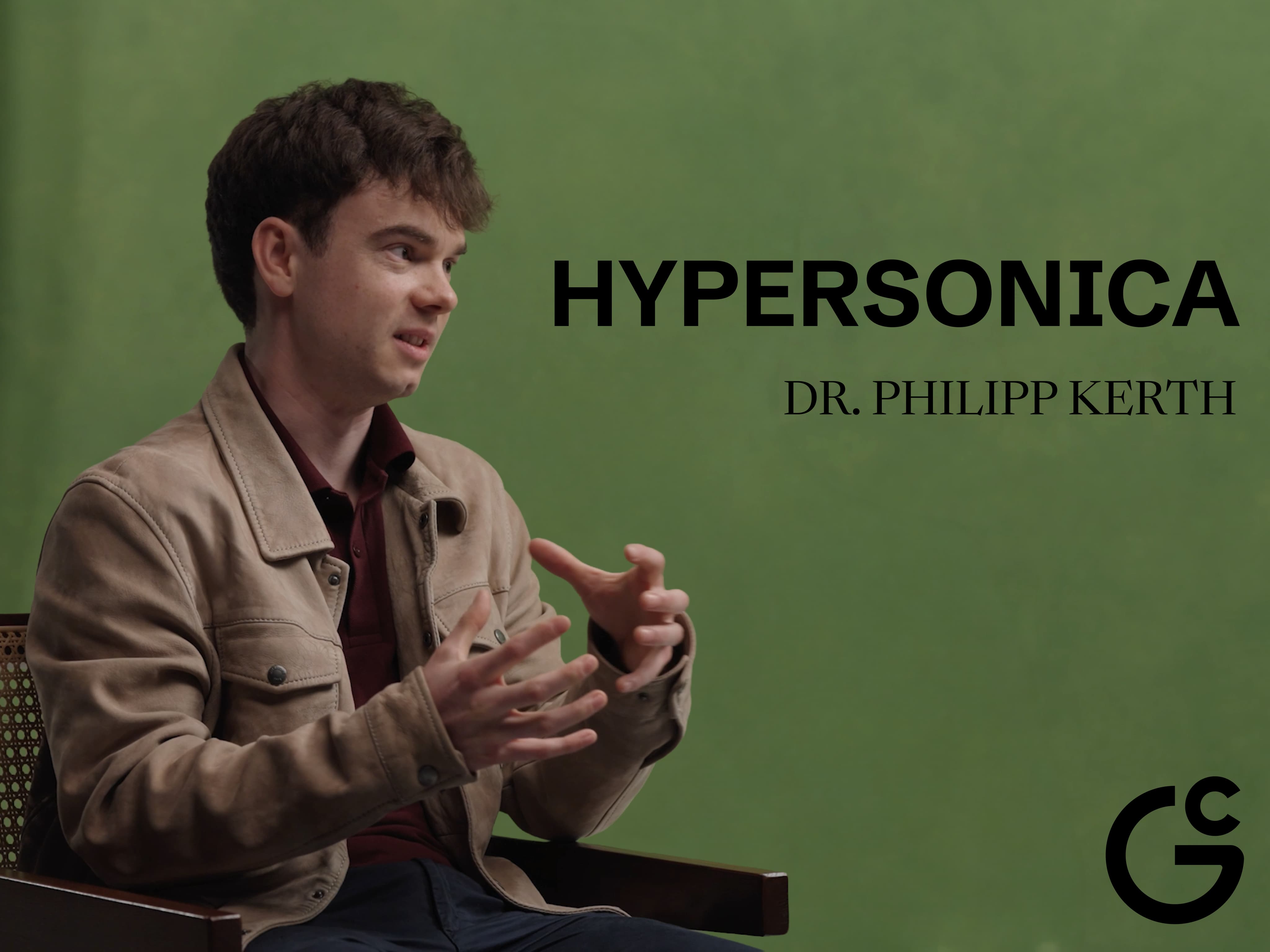
General Catalyst’s Jeannette zu Fürstenberg sits down with Hypersonica co-founder Philipp Kerth to discuss why hypersonic capability is how Europe defends itself and its values.
This interview has been edited and condensed. Watch the full video below.
Jeannette: What is Hypersonica building?
Philipp: Hypersonics is a core technology. It’s the skill to make things fly in a precisely controlled way at extremely high speed through the atmosphere. Right now the main demand is hypersonic weapons, and Europe faces a unique scenario: a continental defense and deterrence challenge. That will give birth to a very sophisticated, very cost-effective way of doing hypersonics. Europe has been extremely good at the underlying research and then badly neglected it for 30 years. We’re taking all of that knowledge and pushing it into real systems as quickly as we can.
Jeannette: I'd love to go back to your youth. What did your professors actually say about you in school?
Philipp: It depends on the age you're asking about. In the very early years, some teachers would have said Philipp has a lot of potential but doesn't really know how to use it. Later, they'd have said he's the one who steps up and does something when others can't. And at university, one professor told me Europe has a big problem losing its best people to the United States—that was after I told him I was thinking about going to the US.
Jeannette: You went to high school in Bavaria, did an undergrad in physics, then jumped straight into a PhD in hypersonics. How does that fit?
Philipp: It doesn’t fit directly. Physics was demanding and I loved it, but it was fundamental, and what always drove me was creating new things. I won a Rhodes Scholarship after my bachelor’s, and at Oxford they didn’t care that I didn’t have a master’s. So I basically hacked the academic system by going from a three-year bachelor right into a PhD. The jump from physics into engineering was tough. I spent nights that first year catching up on subject matter my peers already had.
Jeannette: We’ve been with you since Hypersonica’s seed stage. Take me back to when we first met.
Philipp: The first time we ever met was in person, over tea. The way you listened and the understanding you showed for building this kind of sovereignty was one of the first confirmations that we weren’t the only ones with this thought. At that point, long-range strike weapons were not yet a fashionable topic. Seeing that conviction confirmed from the capital side was incredibly valuable, well beyond the money you invested. That was the point where Hypersonica turned from a relatively wild idea from two people into a strategically important project.
That was the point where Hypersonica turned from a relatively wild idea from two people into a strategically important project.
Jeannette: So many countries have failed for decades at building something viable. What makes hypersonics so hard?
Philipp: Temperature. Everything gets incredibly hot; there’s so much friction and compression when a human body moves through air at this speed that you reach insane temperatures, and they only increase the faster and lower you go. That challenge runs through your entire system. Your skin changes shape when it’s hot. Similarly, there are more stresses in the metal and ceramic parts of the rocket and the guidance system has to deal with it. It’s a whole-system challenge defined by an extreme environment.
Jeannette: Walk me through the breakthrough.
Philipp: The breakthrough is the pace: getting the entire backbone of hypersonics into one company that can go from scratch to a finished prototype in nine months. Simulation is great for design and first judgments, but it always has to be backed by real-world data, because the only way you find out if hardware works is if you try it. That pathway, from an idea through simulation, ground testing, and flight testing, is the new perspective we’ve brought into the European defense and deterrence market.
Jeannette: What did you tell your team the night before the first test?
Philipp: We were around 12 people when we planned HS, very high talent density, everyone with full ownership of their area. We signed up for the earliest test slot we could get in Norway, and many people looked at us in disbelief. The secret was psychological safety. We knew internally how ambitious the timeline was, and we knew we were going to give it our best shot, so whatever happens happens. I told the team that the real success is getting here, with the prototype on the rail and all of us in the control room. We should feel proud of whatever happens now. If I put it in an exaggerated way, there was no pressure to achieve anything, but there was a positive ambition to achieve everything.
If I put it in an exaggerated way, there was no pressure to achieve anything, but there was a positive ambition to achieve everything.
Jeannette: Take me into the room.
Philipp: I was in the control room, so I didn’t see the rocket. My co-founder Marc was outside because he wanted to see and hear it. I got to say a few words over the microphone and give the final go-ahead. The rocket fired, the windows were shaking, the building was rumbling. I saw it disappear on the screen, and then all the sensors and systems were playing data back in real time. Well before the flight concluded, that was a massive achievement for the team. And believe it or not, the first thing I thought was: when are we doing the next one?
Jeannette: There’s controversy around offensive systems. Why do we need deep-strike weapons as part of a deterrent?
Philipp: I was extremely fortunate to grow up in a free, democratic, wealthy, and safe Europe, and I don’t take that for granted. Around the world and across history, it’s bad in most places and most of the time when it comes to those values. I want to preserve it with everything I can. Deterrence, stopping wars before they start, happens in the minds of our adversaries. You get there by having the capability to strike targets deep in adversary territory within minutes. That message builds the pressure not to attack, and it’s what’s lacking today. We can’t claim our values and uphold our democracy if we aren’t able to defend them. Everything flows from there.
Jeannette: If you reduce European sovereignty to one idea, what is it?
Philipp: Strategic decision-making. Whom we work with, whom we partner with, what technology we own, what our dependencies are. If Europe can make those decisions sovereignly, that’s sovereignty to me. A large part of it comes down to independence on defense and deterrence, and from there to technological sovereignty, chips, energy, resources. It all starts with being able to say we can do this on our own, so we’re free to make the rest of the decisions, and not be held hostage by anyone else.
Jeannette: What are you impatient about?
Philipp: Going back. The first thing I felt after the flight was: when are we doing the second? Then I told myself, Philipp, calm down for ten minutes. But the way we work now, we can’t wait to get back out there. We want systems in the market for a deep-strike capability by 2029, and there are many more test flights between here and there. We have the impatience to close that gap.
%201.svg)