
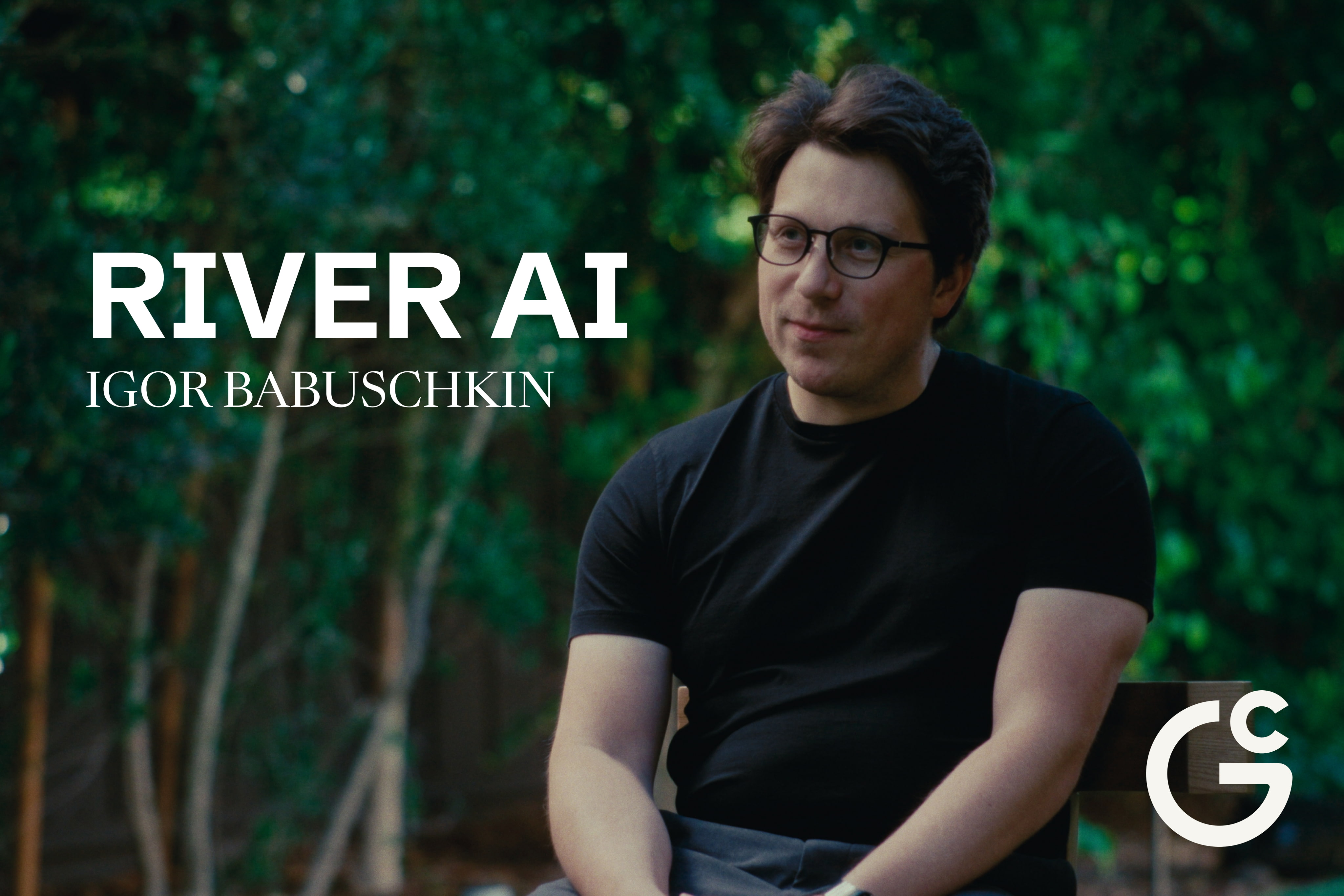
A conversation between Hemant Taneja and River AI founder Igor Babuschkin.
Today, using the most powerful AI means renting it. Those models live inside a handful of labs, reached one token at a time through metered APIs, on whatever terms the labs choose to set. A growing number of researchers expect that to change: open models, whose weights anyone can download and adapt, will carry most of the world's AI usage within a few years. When that happens, the advantage shifts to whoever owns the model, whether that's a company that wants to control its own intelligence, a country that wants AI infrastructure it can rely on, or an individual that wants to work with open-weight models that can continuously learn like a human.
Igor Babuschkin has spent his career inside those labs, working on generative models and WaveNet at DeepMind, the GPT-2 and GPT-3 scaling era at OpenAI, and advanced reasoning models alongside Elon Musk at xAI. He built River AI to hand control back to the public. The full-stack AI company's first product, the River API, lets any developer fine-tune an open-weight model on their own data, without a dedicated AI team or the infrastructure of a big lab.
To celebrate River's $1.1 billion funding round, General Catalyst's Hemant Taneja sat down with Babuschkin to talk about the case for open models, building a durable business while giving its weights away for free, and putting control of AI in the hands of every company, and eventually every person.
This interview has been edited and condensed. Watch the full video below.
The Conversation
Hemant Taneja: You've had a tremendous career: DeepMind, OpenAI, xAI and now River. How did you get here?
Igor Babuschkin: I started in physics, because I wanted to understand the universe and use my skills to help people. That changed when AlphaGo came out. Around 2015 and 2016, DeepMind was showing amazing results, and I realized the most exciting work over the next few years would be in AI. I found a way to switch fields and joined DeepMind, working on generative models and text-to-speech with WaveNet, and I got really interested in reinforcement learning, which I've now been doing for ten years. Then I joined OpenAI because I was drawn to their scaling philosophy. It felt like they were onto something with GPT-2 and GPT-3, so I helped on some large training runs. I was also interested in reasoning, which large models weren't good at yet, and that's really changed. One thing that has always motivated me is making sure there's a lot of diversity in AI. It can't be one large company that controls everything and decides what you're allowed to do.
It can't be one large company that controls everything and decides what you're allowed to do.
HT: Bring me back to when we met, and what got you excited about starting xAI.
Igor: I felt it would be amazing to have another strong competitor with a different philosophy about how to contribute to humanity and what kinds of models to build. When I met Elon, I saw a chance to do something new around understanding the universe: can we build powerful reasoning models that help us solve problems in physics, science, medicine, and engineering? Elon was interested in whether the models could help him build a better rocket engine. Reasoning models weren't out yet, so we made a bet that LLMs would get much better at reasoning, which turned out to be right. We did some really powerful work with Grok on coding and advanced reasoning. I realized that this is going to change the world, these models will keep getting more powerful, and the big AI companies own and control the technology. What happens to the hundreds of thousands of companies, and to every person in the world, if they can't have full control of their AI experience?
HT: That's where I feel deep alignment with us at General Catalyst, because our whole focus is on creating unfair advantages for founders so they can build companies at a scale that matters—in a world where you have these really large tech companies. The xAI story became part of that, and now it's a trillion-dollar juggernaut. But you saw the next phase of what AI needs to do: putting power into the hands of consumers and users. What's pulling you to build the way you are now?
The xAI story became part of that, and now it's a trillion-dollar juggernaut. But you saw the next phase of what AI needs to do: putting power into the hands of consumers and users.
Igor: AI is done the way it's done today because we made a lot of assumptions. The idea that LLM APIs are the primary way you get intelligence, where you pay per token, is just one way to build AI. We believe that if you build it in a more open way, one that lets people shape and control the AI systems they build, whether it's a company that wants to own its own intelligence, or an individual who wants to tune their AI to be just right—that's how the majority of the world will use AI in the future. It should be open, freely available, and cheap, and you should feel like it's working for you and not for somebody else. The key is building the right tools and technology. We're a research lab figuring out what the tools of the future are, the algorithms that let people take control of their AI experience.
HT: You started River with a premise around open weights, so you've been very early to this. What gave you the conviction?
Igor: Two reasons. The first is pure prediction. We're getting better at forecasting where AI is heading, and we saw open models getting stronger and closing the gap with proprietary ones, driven especially by very strong teams in China. You can draw the line on the graph and estimate they'll get very close this year, and might surpass the proprietary models one day. The second reason is philosophical. These models are trained on all of human knowledge, everything written on the internet. It's humanity's contribution, and the best way to distribute the benefits of that is to give the outcome away for free. So when we do pre-training, those weights should become available to everyone.
These models are trained on all of human knowledge, everything written on the internet. It's humanity's contribution, and the best way to distribute the benefits of that is to give the outcome away for free.
HT: If you're giving the weights away, what does the commercial business look like?
Igor: For this to be self-sustaining, we need a business model around the open weights. The key is the advanced tools that let you customize and shape the model. At the business level, a company might have internal data and want the perfect model for its use cases, something small, cheap to run, and reliable that solves the task every time, and we build tools for that. The harder part is the individual level: helping someone tune and control their AI the way only a big lab can today. Imagine telling your AI, "write the code differently, speak more casually next time," and the model absorbs that and changes at the weight level, actually improving in that direction. That's not really possible today, but with the right research we can pull it off. It would be a whole different stack for AI—a whole different world.
HT: There's a lot of discussion around sovereignty, because so much open-weight model work is done by Chinese companies. What's your philosophy?
Igor: We absolutely should have open models in the US that are much better than the ones coming out of China. There are security concerns, like what if someone embeds behaviors in the weights, but there's also the fact that whoever releases these models controls part of the ecosystem, because companies come to rely on the weights. The Chinese labs might stop releasing their models or restrict them.
HT: …And you might fall behind as a result.
Igor: Exactly, so it's very important we invest in this. We've actually done it in about two years, from scratch: the team, the datasets, the training infrastructure, the architecture, and algorithms. So I'm very confident that here in the US we can do this. It's about the right incentives, building the right team at the right time, and I hope that's going to be River. We're excited to start training our own models too, but for now, the focus is fine-tuning and customization through the River API, helping companies take an open-weight model and run very ambitious training runs that you'd usually only be able to do at a big AI lab.
HT: One thing I've been pleasantly surprised by is that the enterprises you're talking to actually get that they need this. Talk about the market sentiment.
Igor: As these models get more capable, they start to subsume all kinds of industries and existing tech companies. People are realizing that if they just let the big AI labs train on their data, they're giving up control, giving away a lot of what makes their business work. So they should take back control, train their own models, and build an internal self-improvement loop for their own intelligence.
So they should take back control, train their own models, and build an internal self-improvement loop for their own intelligence.
HT: Fast-forward a couple of years. How do you see enterprises and consumers using frontier AI models, both closed and open?
Igor: I think we might see a bifurcation. Right now there's essentially one frontier that everybody uses, the most capable models from OpenAI, Anthropic, and others. But in the future I could imagine very capable, superintelligent AIs that are closed off, where you'd have to be a large corporation or a government to access them, and then the AI for everybody else. The proprietary labs become the experts of that first category, but open models dominate the second, because the weights are free and there's not much incentive to pay someone an extraordinary amount.
HT: Let's talk about continual learning. What does it mean, and where is the field going?
Igor: Continual learning has been a direction in deep learning for the whole ten years I've been doing this. The idea is for models to learn like a human, continuously, without forgetting old knowledge while training on new data. For us, it's the answer to a specific problem: today there's no great way for an individual to shape their model, so we rely on the big labs to post-train and tune them. We want the individual to have control. So when a user says, "be more casual, like we're friends, you don't have to be so formal," we kick off a learning process that updates the model's weights. There are a few interesting directions, like online reinforcement learning, where you continuously train the model from user interactions like a recommendation system, and on-policy self-distillation, where you turn a natural-language prompt into an actual weight update. We're exploring where these fit best for letting the individual take control.
HT: As this ecosystem develops, what does the landscape look like in four to five years?
Igor: My suspicion—and I should say there's a lot of uncertainty in predicting that far ahead—is that the usage of open models will increase even further, and that the majority of usage out there, from both companies and individuals, will be based on open models. Which is a reversal from how things started out. Initially, the closed AI labs were the trailblazers and innovators—they came up with all these amazing things, and they're still continuing to grow. But the economics, the convenience, and the various advantages of open models will, I think, prevail in the long term.
Initially, the closed AI labs were the trailblazers and innovators—they came up with all these amazing things, and they're still continuing to grow. But the economics, the convenience, and the various advantages of open models will, I think, prevail in the long term.
HT: How does River itself work? What does a developer do with the API?
Igor: We've all been using LLM inference, running a trained model to get answers: there's a checkpoint (a saved version of the model), you prompt it, and a stream of tokens comes back. River asks, what if we extend that with the ability to update the model weights too? So instead of talking to a frozen checkpoint, you can actually instruct the model, embedding continual learning into it.
HT: So the interaction is literally the same.
Igor: Exactly. The API is very flexible, letting you specify exactly how the weights should be updated. Being able to both sample and update the weights lets you express all kinds of workflows, post-training or reinforcement learning, so if you want to compete with the best training runs from Anthropic and OpenAI, you can do that through the API. We've also found LoRA adapters (a lightweight way to fine-tune a model without retraining all of it) extremely helpful, because they make training and inference efficient, so you can sample from the model as you update it with very low overhead, which makes the whole thing much cheaper and more accessible. Our early users tell us the API is reliable and scalable with really good step times, and we're proud of that feedback.
HT: You could go in so many directions here. How are you thinking about the next couple of years?
Igor: Today it's much more realistic to help larger companies take control of their AI experience, which is why we've built the API, so there's a clear path for companies now. But it requires a lot of data and the ability to code, so it's not yet useful for every individual. That's the ultimate goal: we want to figure out how every single person in the world can take control of their own AI experience. So we're doing a lot of research into the techniques we can use to let an individual shape the model. Maybe the model should automatically improve itself based on its interactions with you. That's the automated goal, and it means that ultimately we want to release tools for consumers as well. But that's in the future. Today, we're heavily focused on helping businesses take control of their AI and build sovereign AI.
That's the ultimate goal: we want to figure out how every single person in the world can take control of their own AI experience. So we're doing a lot of research into the techniques we can use to let an individual shape the model.
HT: If a Chief AI Officer of an enterprise is watching, what's the one message you want to give them about getting on this open-weight journey?
Igor: It's much, much easier than you think. With a coding agent and the API, we can implement a very complex reinforcement learning run in 15 to 20 minutes, and you don't need a ton of expertise in reinforcement learning at all. The barrier to entry is very low. You can try it out, create some impact internally, and scale from there.
%201.svg)