.jpg)
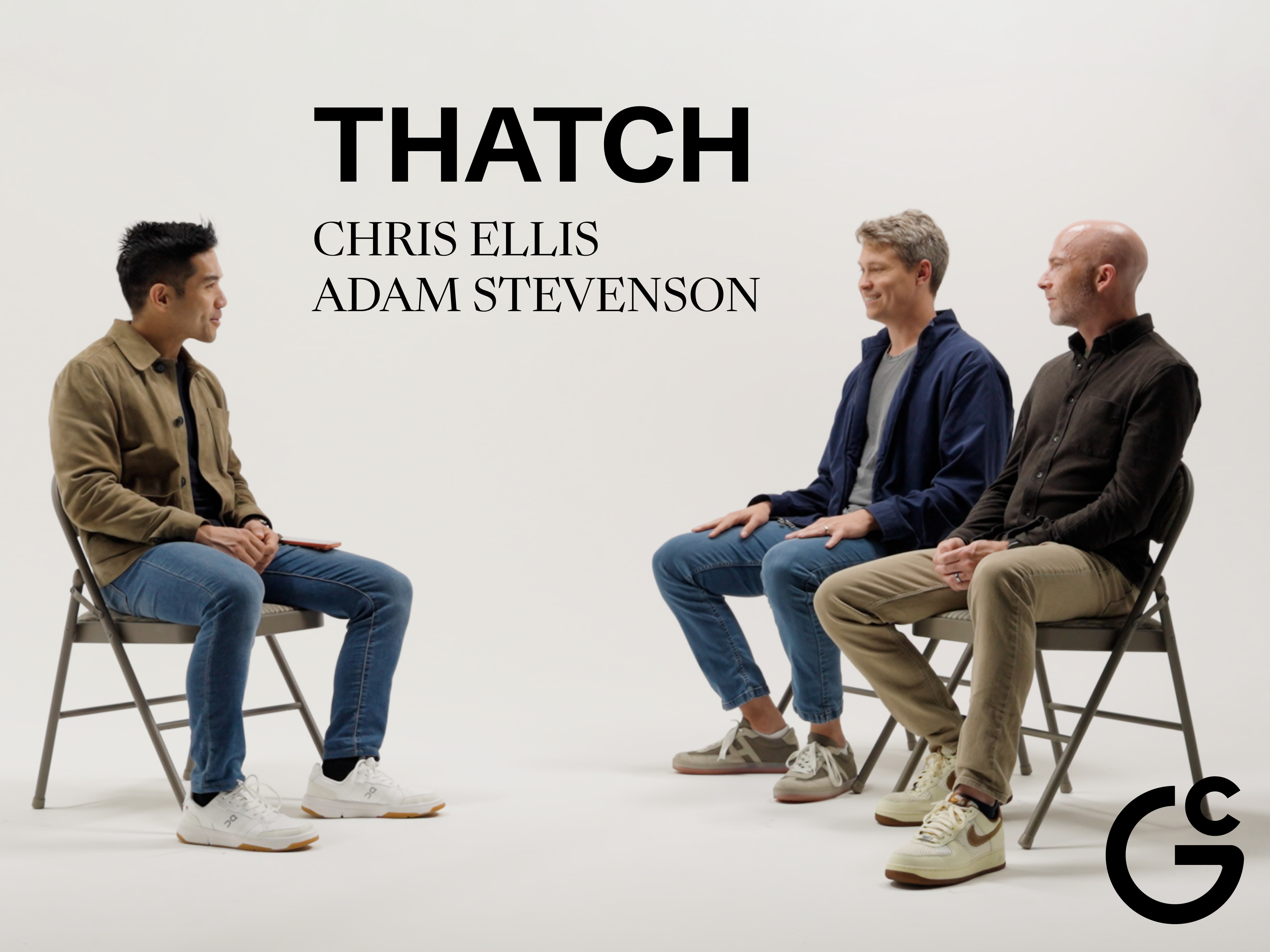
General Catalyst's Alex Tran sits down with Thatch co-founders Chris Ellis and Adam Stevenson to discuss why letting employees buy their own plan is a leap toward a healthcare system people love.
This interview has been edited and condensed. Watch the full video below.
Alex: Many would say our nation is in a healthcare crisis. Costs are spiraling, consumers are carrying a heavy burden, and employers are breaking under the weight of taking care of their employees. How did we get here?
Chris: Consumer sentiment in healthcare is at its lowest point in decades. We pay far more in the U.S. for far worse coverage, and life expectancy is lower than in developed nations that spend a fraction of what we do. But the system is functioning exactly as it was designed. The problem is the accident of its design.
The employer-based system traces back to World War II. After a wage freeze, employers who wanted to attract workers added health insurance, which at the time covered a single-digit percentage of the population. A decade later, the government made those benefits tax-free to prevent factory strikes, cementing the employer-based model. Over decades of rules layered on top, we perpetuated a system where employers gain significant tax benefits for buying healthcare on behalf of their employees.
That distorts market forces. It's one of the only systems in the world where the person who uses it is the employee, the person who chooses it is an HR team, the person who pays for it is the CFO, the person who sets the rules is a state regulator, and the person who delivers it is a provider. Five links in the chain before you add brokers and insurance companies. The more middlemen, the more opaque the system, the less it functions like a free market. We haven't seen a major new entrant into the employer-based commercial market since the early 1980s.
It's one of the only systems in the world where the person who uses it is the employee, the person who chooses it is an HR team, the person who pays for it is the CFO...
Adam: Healthcare is a super-regulated market, and it's intimidating for founders. I spent six years at Stripe and saw all sorts of companies build on it. Almost nobody was building in healthcare. We all just accept that it's broken instead of trying to fix it.
Alex: Why did you start Thatch, and what is it?
Adam: When Chris and I met, we had both lost parents to cancer, and we wanted to build something for patients. Everybody in healthcare was building for pharma companies or carriers because that's where the money is. So we set off to talk to patients and figure out their problems. Along the way we were hiring people and giving our team health benefits, and we ended up with an insurance plan out of Texas that nobody was happy with. We were trying to give people great benefits and it was very difficult. Then we learned about a law that passed a few years ago that, for the first time, lets employers give uncapped tax-free money to their teams to use for benefits however they want. We started building in that direction, and that became Thatch.
Chris: We've lived in this rigid structure for so long that we've become accustomed to the idea that the employer gets a paternalistic say over their employees' decisions. Most of our customers are small to mid-sized firms that are too small to self-fund the way Google or Walmart can. A 100-person company with one employee who gets cancer pays far more than the average 100-person company, because they carry the risk of their small pool. When they move to Thatch, they join the much larger pool of everyone in the country buying individual insurance, which is north of 20 million people today, up from zero when the ACA was created. Like the strands of straw on a thatched roof, every individual is small, but bound together they create shared purchasing power.
Alex: As a customer, what am I buying?
Adam: For an employer it's fully self-serve. They sign up, connect their bank account and payroll, set a budget, and invite their team. Everyone on the team gets an invite into Thatch, where they select their health, dental, and vision insurance from the budget their employer gave them. A couple of days later they get a debit card in the mail they can take to CVS for a prescription, use to pay a medical bill, or use to see any therapist they want.
There are no category-defining brands in healthcare. There is no Apple of healthcare. There is no Airbnb of healthcare. Healthcare is deeply personal and very human, and there aren't great consumer brands people associate with a great experience. We think there's an opportunity to be that.
There is no Apple of healthcare. There is no Airbnb of healthcare. Healthcare is deeply personal and very human, and there aren't great consumer brands people associate with a great experience. We think there's an opportunity to be that.
Alex: How should I think about whether my company is right for Thatch?
Chris: We serve companies from inception to several thousand employees. For a first-time healthcare purchaser, navigating group health insurance is Byzantine, so startups come to us for the simplicity of a defined budget and the choice it gives their employees. Mid-market companies are dialed into total cost per employee. Often they found us because they got a 20%, 30%, or 40% renewal increase and want to offer a comparable plan without paying 40% more. Because we have so many carriers across so many regions, we can often find a configuration that treats their employees better on coverage quality while minimizing financial exposure.
Adam: Thousands of companies use Thatch, and about half have fewer than 50 employees. We have almost every sector of the U.S. economy represented, from solopreneurs to multi-thousand-person enterprises, trucking companies, churches, nonprofits, law firms. Giving choice and control to employees resonates across a very wide spectrum.
Alex: You're both a healthcare and a fintech company. Many people don't appreciate the fintech side. What does it take to build Thatch?
Adam: The thing we're most proud of is the quality of the team. From very early on we focused on talent density, bringing in some of the best early employees from Stripe, Shopify, Robinhood, Rippling, and Ramp, with a heavy filter for people who were mission-oriented and great teammates.
A lot of our hardest technical challenges are fintech problems. How do you take a payment from one employer, split it, and send it to 15 insurance companies that are all idiosyncratic in how they bill? How do you deliver a card a consumer can use anywhere for healthcare, then adjudicate that the payments were for healthcare and manage compliance? On the healthcare side, we integrate directly with carriers to process enrollments, because we want users to select a plan on Thatch and never think about it again. Carriers aren't known for great APIs.
Chris: Fintech engineers ask me all the time, I don't understand healthcare, what can I offer? It's far easier to take someone solving hard infrastructure problems and teach them healthcare than to take a healthcare expert and teach them fintech and how to build a delightful user experience. We have a healthcare book club at Thatch. We've gone end to end integrating with carriers you've heard of, and at the end they told us we were the only ones who ever finished. That was because smart engineers were willing to slog through their docs.
We also have a growth leader from UnitedHealthcare sitting next to a fintech engineer from Stripe. What connects them is the mission to build a healthcare system people love.
Alex: How is AI changing your business?
Adam: Two categories. Internally, our entire engineering team has adopted tools like Cursor, Claude Code, and Graphite, and one of our most senior engineers told me we're now bottlenecked on code review. We're producing so much code that the effort has shifted to reviewing it before it ships.
In the product, we use AI everywhere we'd otherwise have to scale with people. Ask Thatch is a chatbot that answers questions about your plan and helps you choose one when you have dozens of options. We use AI to adjudicate receipts, so we know a payment was for healthcare and not Taylor Swift tickets. And we use low-latency voice models to call providers in the background and confirm that the plan someone is picking is in network with their doctor. We take that burden completely off the end user.
Chris: Thatch could not get to scale without AI. There are a million health insurance brokers in the U.S. advising employers on plans. There are far more individuals than employers, and if every consumer has to choose from a hundred plans, we can't have the whole population become health insurance advisors. AI democratizes access to highly specialized knowledge, explained in a relatable way. It's incredibly good at reading a hundred plan documents, which are designed to be confusing, and answering your actual question. I want to see this OB-GYN, I need this medication covered, I'm thinking about getting pregnant, what's the best plan for me?
Alex: How do you see the nature of work changing, and where does Thatch play a role?
Chris: Healthcare is the last vestige of feudalism in American society. The original employment agreement was modeled on a lord and the people who worked his land. You worked there for life, and in return that entity covered your income, retirement, healthcare, and death benefits. For most of the 1900s people stayed at the same job for decades, so it made sense.
Over the last few decades that relationship has been unbundling. Pensions unbundled retirement in the 70s. Average tenure fell to four years. The internet unbundled skills and training, the gig economy now accounts for 36% of the workforce, and COVID unbundled the office. AI is only going to accelerate that. I've never seen a period where leaders can lay off large portions of their workforce, cite AI, and get applauded by the stock market. The people paying attention are those entering the workforce, and Gen Z is the ultimate articulation of feeling disempowered by the system. In a world where the responsibility an employer takes for an employee is changing, we should create structures that allow greater independence from the employer. If we decouple healthcare from employment, we have a real shot at letting people navigate a system in which the social contract has been rewritten.
In a world where the responsibility an employer takes for an employee is changing, we should create structures that allow greater independence from the employer.
Adam: Practically, people are switching jobs more often, and every time they do, they get a new insurance company and often have to change their doctor and their therapist. That doesn't make sense. Thatch enables benefits portability. The plan belongs to you, and you take it from job to job.
Alex: If you were a policymaker today, how would you solve the healthcare crisis?
Chris: Two solutions come to mind. In Switzerland, everyone has a budget to purchase healthcare through a defined contribution, and the competitors are private companies that can enter and exit markets, sell directly to consumers, and put their money into R&D and actuarial analysis instead of distribution. That's one of the big challenges in the U.S., the high cost of distribution and administration. I don't believe Medicare for All is the solution. You need a private marketplace that's competitive, where everyone can participate and pool risk. It's not fair that a small business sits in a disadvantaged risk pool relative to Walmart. Part of the barrier to entrepreneurship today is simply that healthcare is far more expensive than at a large corporation.
In Singapore, insurance plays its canonical role of covering catastrophic events. Your car insurance doesn't cover oil changes. The rest of the budget goes into savings accounts that are like a turbocharged HSA, so consumers have real dollars to wield. That creates competition at the provider level, not just the insurer level. You can look up the published price of a root canal, because dentistry is largely free from insurance. The price of an MRI varies 30x in the average market because there's no incentive to publish prices. In a world where you can win business by publishing a better price for a better service, the people delivering worse experiences at worse prices get outcompeted. That doesn't happen today.
Alex: Can a country of 350 million people model itself on nations of eight to ten million?
Chris: The American healthcare system isn't really a national system. It's a patchwork of fiefdoms, where Maryland looks different from California and Texas. Competition happens at the local level, so every state is its own mini Singapore or Switzerland. What's problematic about the employer-based system is that it forces national policies. Blue Cross, United, Cigna, and Aetna have such strong market power because employers span geographies and networks have to be national. It would be far more efficient to have local health plans in every market.
Alex: What's the optimistic view of what our healthcare system could look like if you get it right?
Chris: Kaiser is one of the only systems where the provider is also the payer, and it's very efficient. Why can't Memorial Hermann in Houston or Mount Sinai in New York offer insurance and have a direct relationship with the consumer? In 10 years we'll see providers get off the sidelines and into the business of managing risk, with an incentive to manage total cost rather than fight with payers. We'll see insurance products designed for specific consumers, plans for Hispanic women in LA or new dads in New Mexico, because it's very inefficient to design one plan that works for everyone.
In that future, we no longer think about insurance as a stale oligopoly. The same way the iPhone unlocked the internet, we believe defined contribution can unlock the healthcare system in the U.S. and change the way people feel about their own healthcare.
%201.svg)