.jpg)
The lack of sophisticated financial instruments is emerging as one of the biggest constraints to the buildout of compute and thus US economic growth. The scale of this investment has far surpassed past historical capital project. Risk is concentrating into a few critical companies and the market is unable to provide sufficient capital or transfer risk effectively. Financial innovation is needed to bring scale and stability to the AI economy.
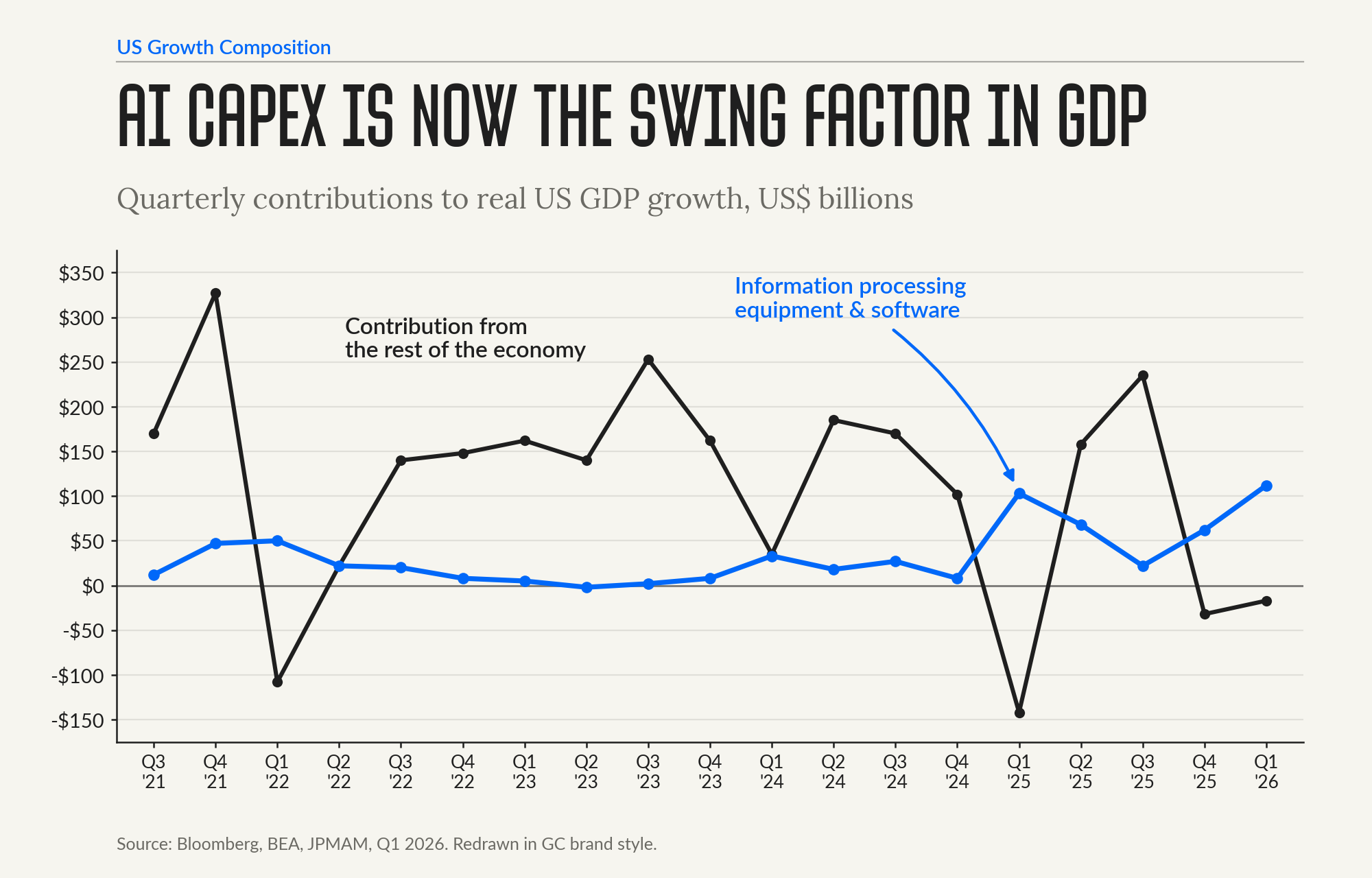
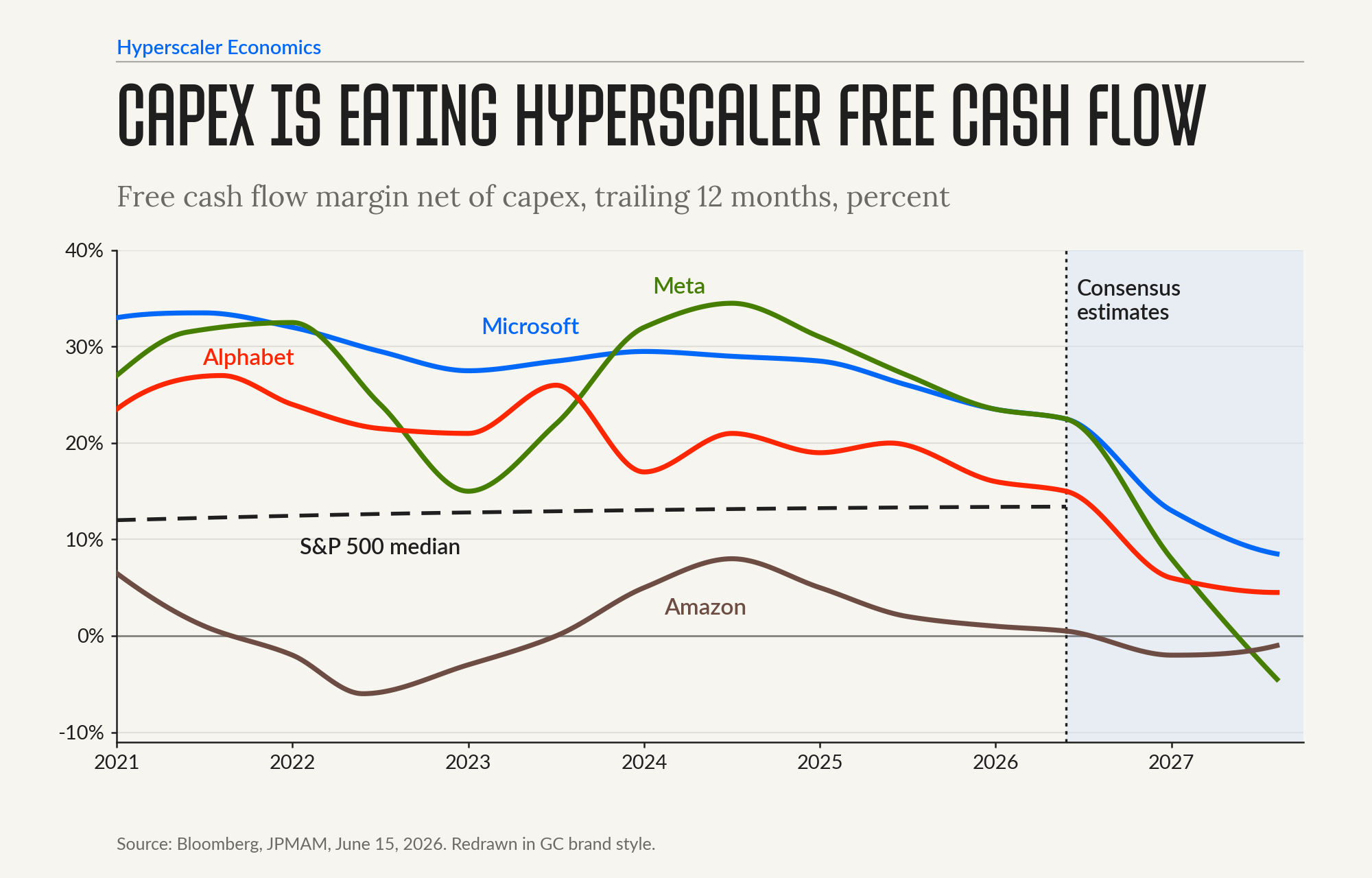
To date, the majority of this buildout has come from the cash flows of the hyperscalers. These enormously profitable businesses have financed much of this economic revolution to date. This is changing as hyperscalers are driving towards negative free cash flow and forced to use leverage to finance the scale of their ambitions.
As compute becomes the critical resource of the modern economy and the financial structure moves beyond hyperscaler cash flow and select private credit funds, the industry will require sophisticated financial instruments to effectively manage risk. A few companies are seeking to build the financial data and index backbone of this ecosystem. These efforts are nascent but the significant increase in industry-wide leverage may be the catalyst which drives adoption of the financialization of compute.
AI Financing Dynamics
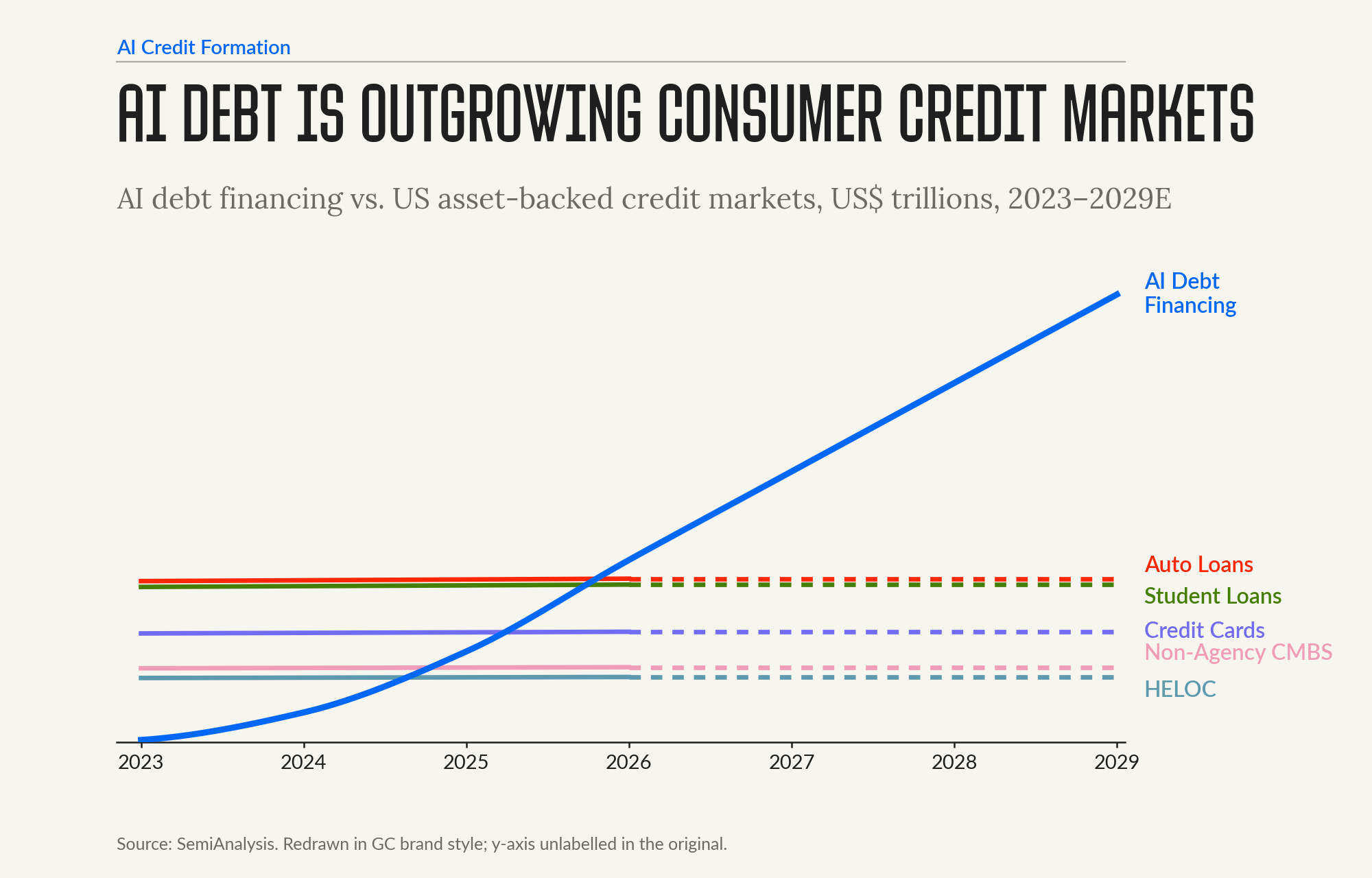
The shift from funding the compute buildout with cashflow to debt is going to create an enormous market which existing incumbents are not prepared for. Semianalysis estimates that AI debt will reach $7T by 2029, making it the second largest asset-backed debt market behind the US mortgage backed market at $13T+. The market is not ready for this.
From SemiAnalysis: “In 2025 datacenter capacity was the bottleneck for AI compute growth. By early 2026, the datacenter supply situation improved considerably, but… chip production was the limiting constraint. Now … it is clear that financing will be one of the most significant obstacles to ramping large scale compute broadly available to everyone”
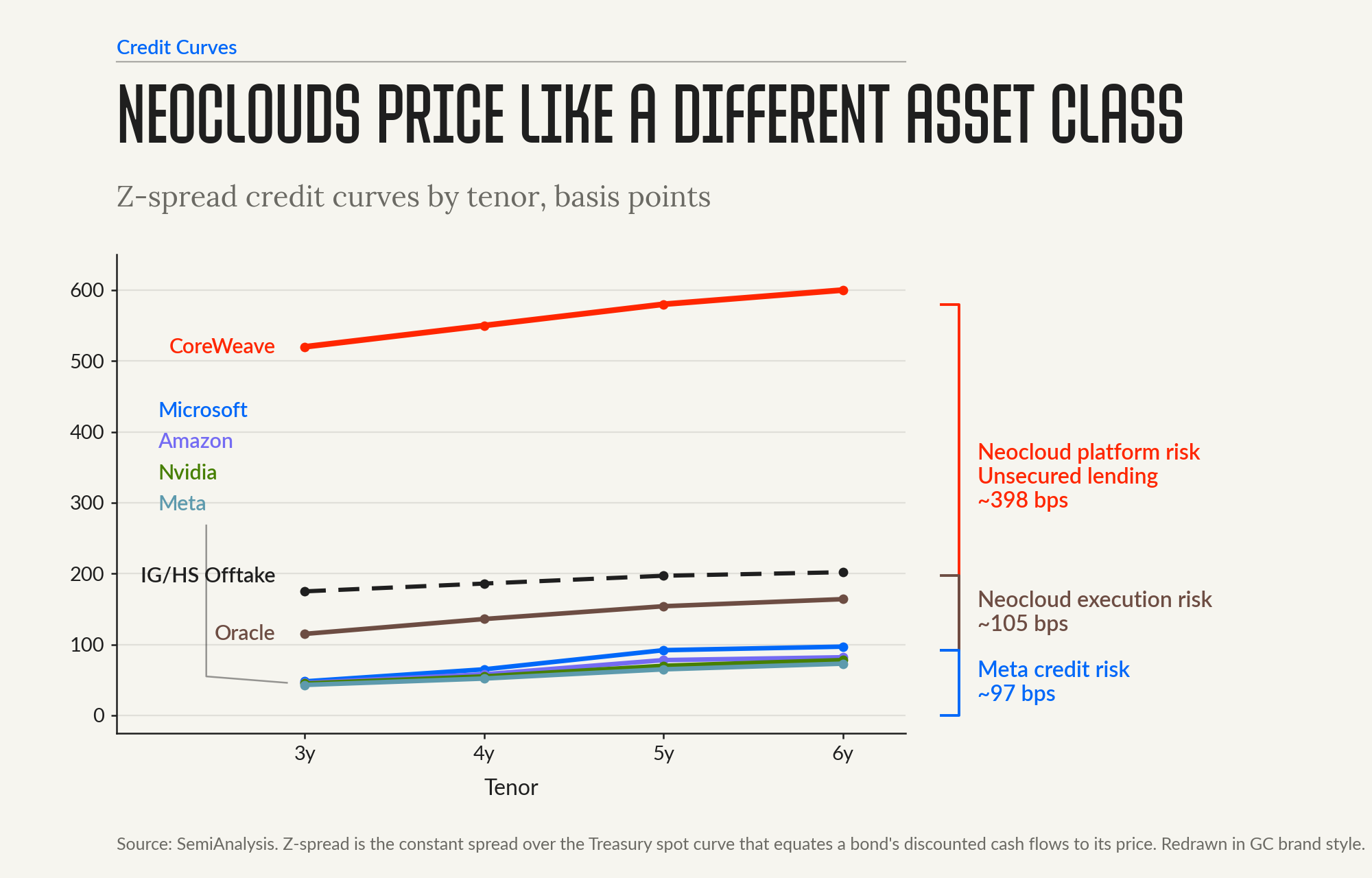
The current state of the AI debt market is limited by lenders’ concern about the instability of the market. Accordingly the majority of debt is secured against long-term offtake contracts with the hyperscalers so a lender is predominantly underwriting the hyperscaler’s credit profile, not the underlying demand for compute. This implicitly pressures margins for the neoclouds as these contracts are on favorable terms and creates a chokepoint in the supply chain with five companies controlling this critical resource
Currently the debt markets are charging a 4% premium for neoclouds unsecured lending above the IG offtake contracts. This makes it broadly uneconomical to sell compute to any other party apart from the hyperscalers on long-term contracts at scale.
Nvidia (and AMD to a lesser extent) is trying to solve this issue by backstopping GPU rental offtake to neoclouds enabling them to offer shorter duration contracts to a broader set of customers. In these agreements Nvidia commits to a certain minimum cost per GPU hour and then captures a share of the revenue above that level. This accomplishes three key goals for the company:
Increases the diversity of customers
Demonstrates the ability to lend against non-hyperscaler offtake contracts (and eventually spot)
Strengthens the neoclouds (just one way that Nvidia is supporting this ecosystem)
While Nvidia has a large balance sheet, it will not be able to backstop the entire industry. This is a stopgap measure that highlights the need for a broader, and more sophisticated financing ecosystem. The recent $500B consortium of capital that Nvidia has assembled highlights both the need and their focus on using financing as a major lever for growth.
The challenges with AI borrowing are not only constrained to neoclouds. Oracle offers an interesting case study of a hyperscaler that has relied far more on leverage to finance their AI buildout. The CDS spread highlights the risk the market ascribes to their compute-driven leverage. This has proliferated down the stack to Nvidia which as described above is forced to effectively finance a portion of its customers' purchases.
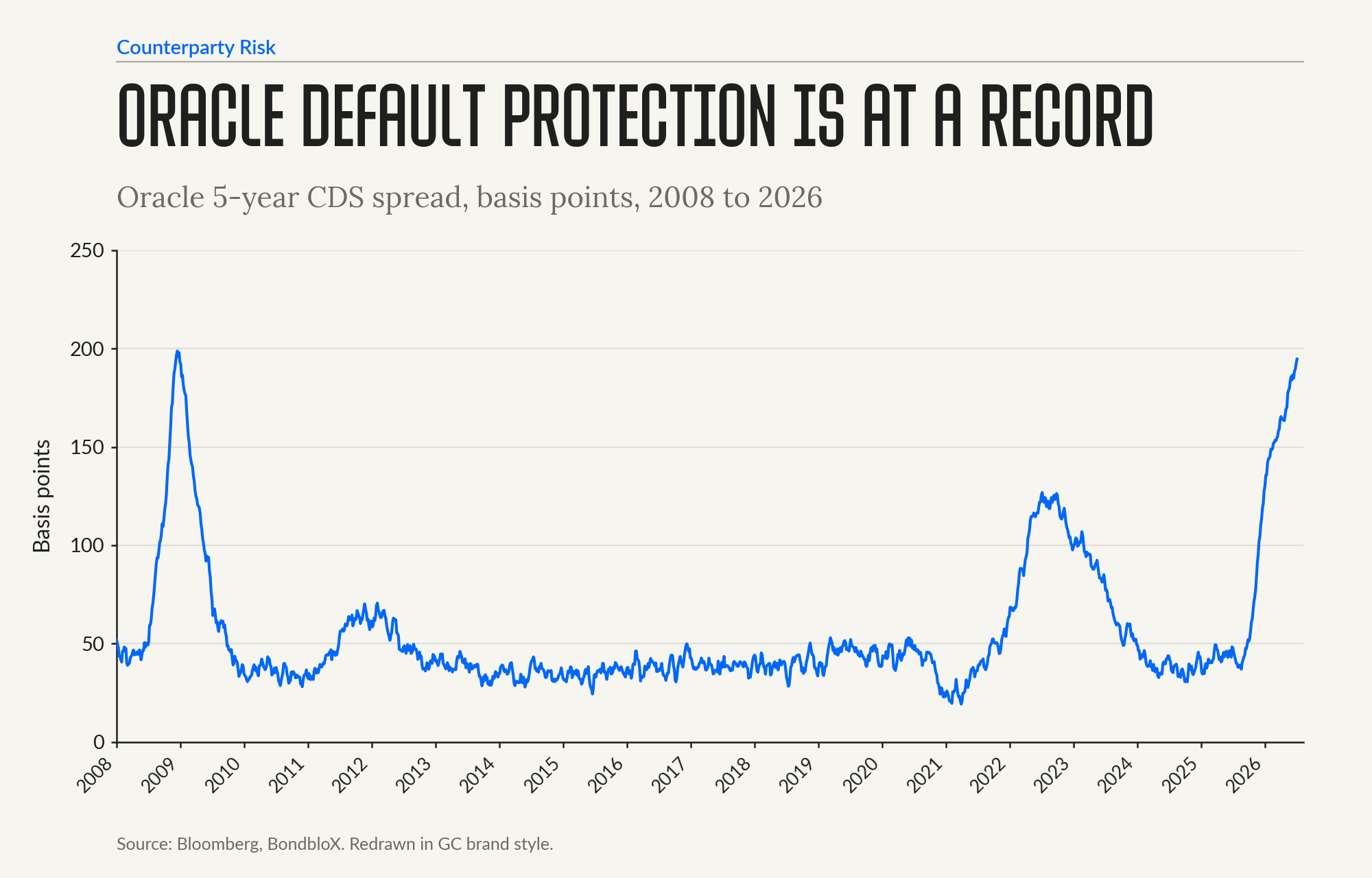
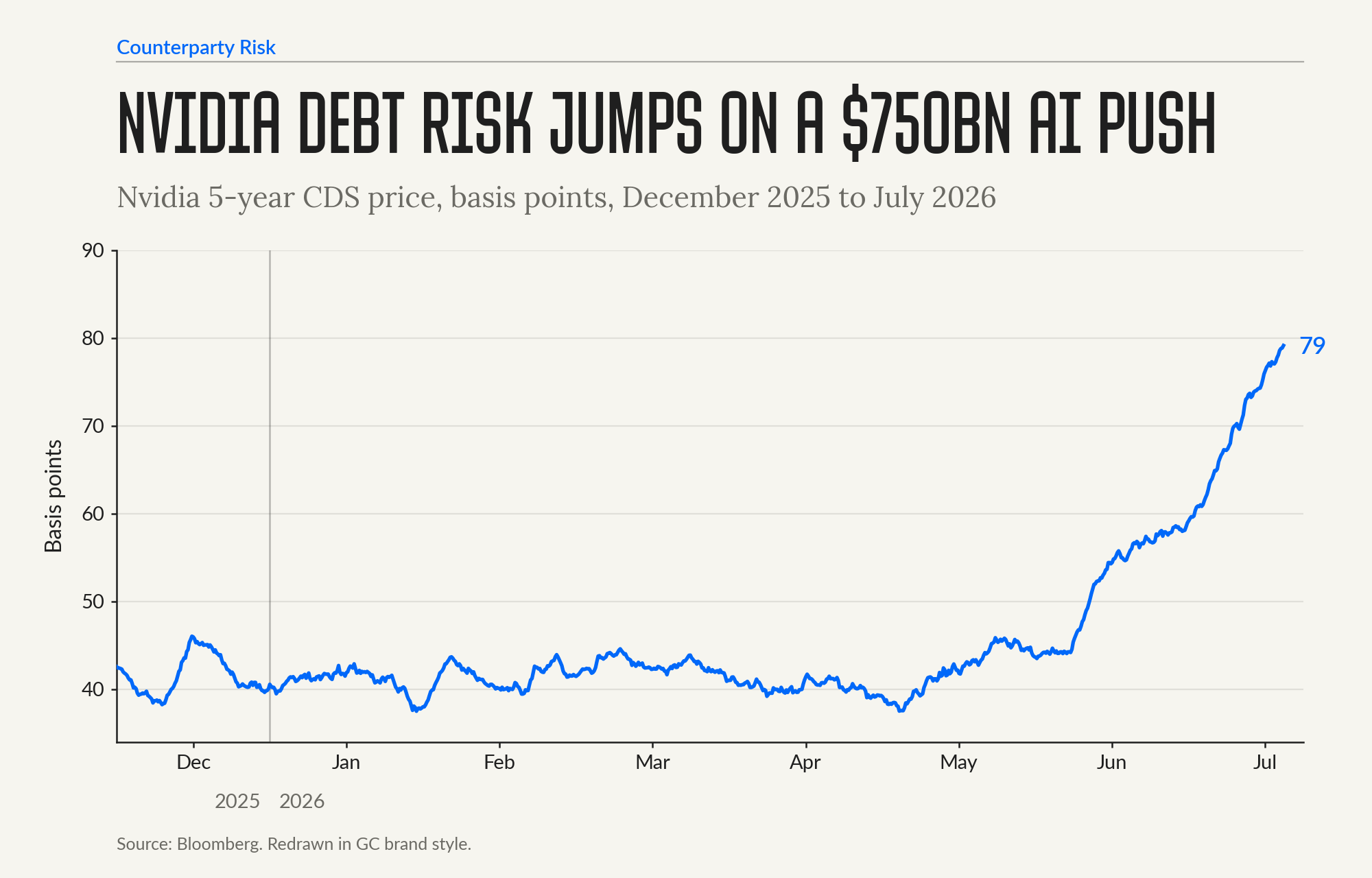
The fundamental issue here is that there is no ability for market participants to hedge the risk of a collapse in compute pricing. In the energy markets, lenders typically require hedging covenants for 50% - 75% of expected volumes. This does not exist today in the compute markets and thus the 4% spread over IG offtake is the cost lenders impose on neoclouds to accept this risk. Solving this issue is critical to unlock the required $7T of debt required to support the AI economy over just the next three years. Speculators may trade first, but lenders demanding hedging covenants are what will force an institutional benchmark into existence
Equity Risk Management and Speculation
Another constituency which is increasingly exposed to compute pricing risk is equity investors. As compute becomes the critical resource of the modern economy, it is increasingly dominating portfolios. Just as investors use commodity hedges to manage risk in the traditional economy, compute markets would enable hedge funds to do the same for the AI economy.
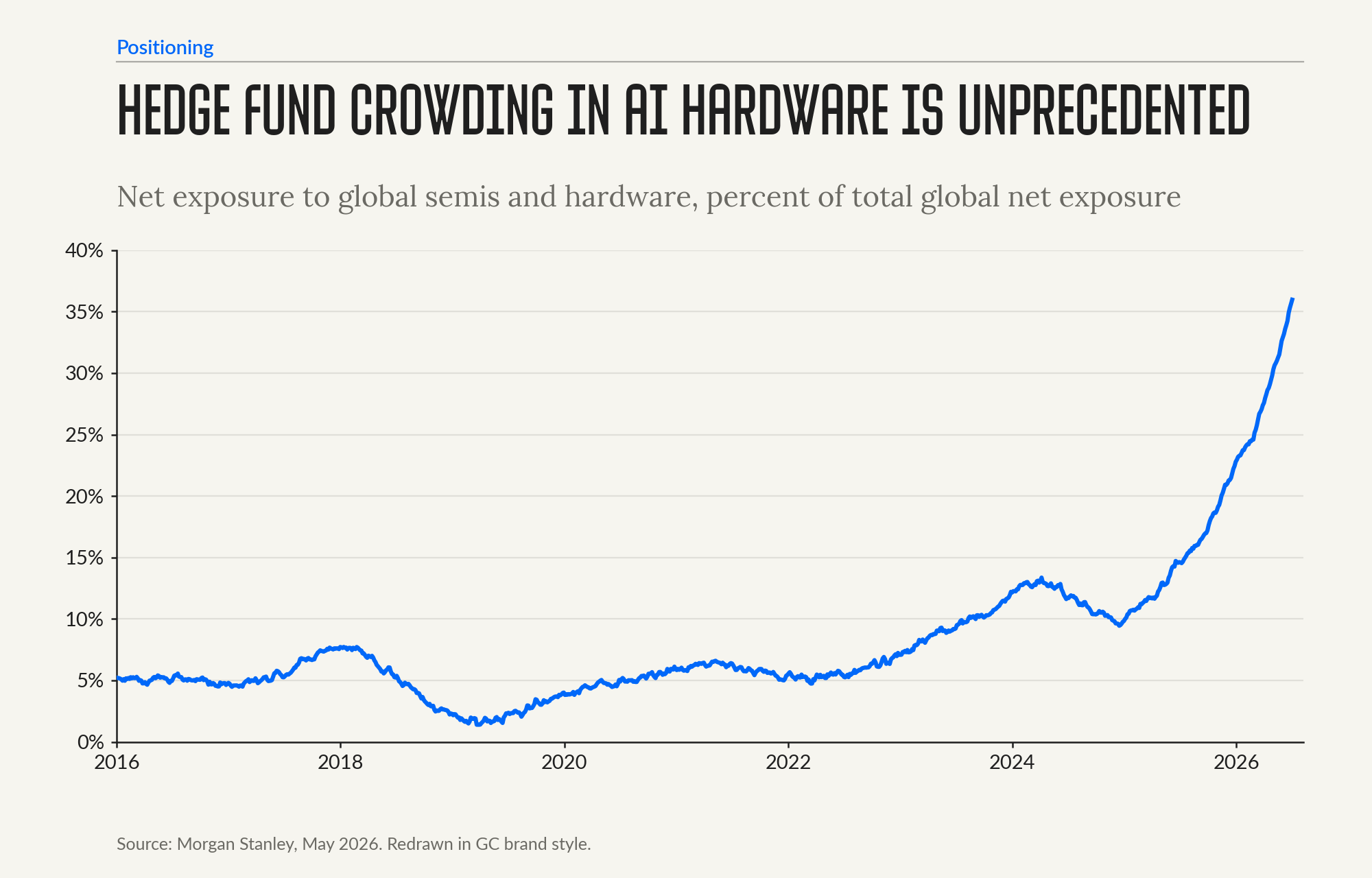
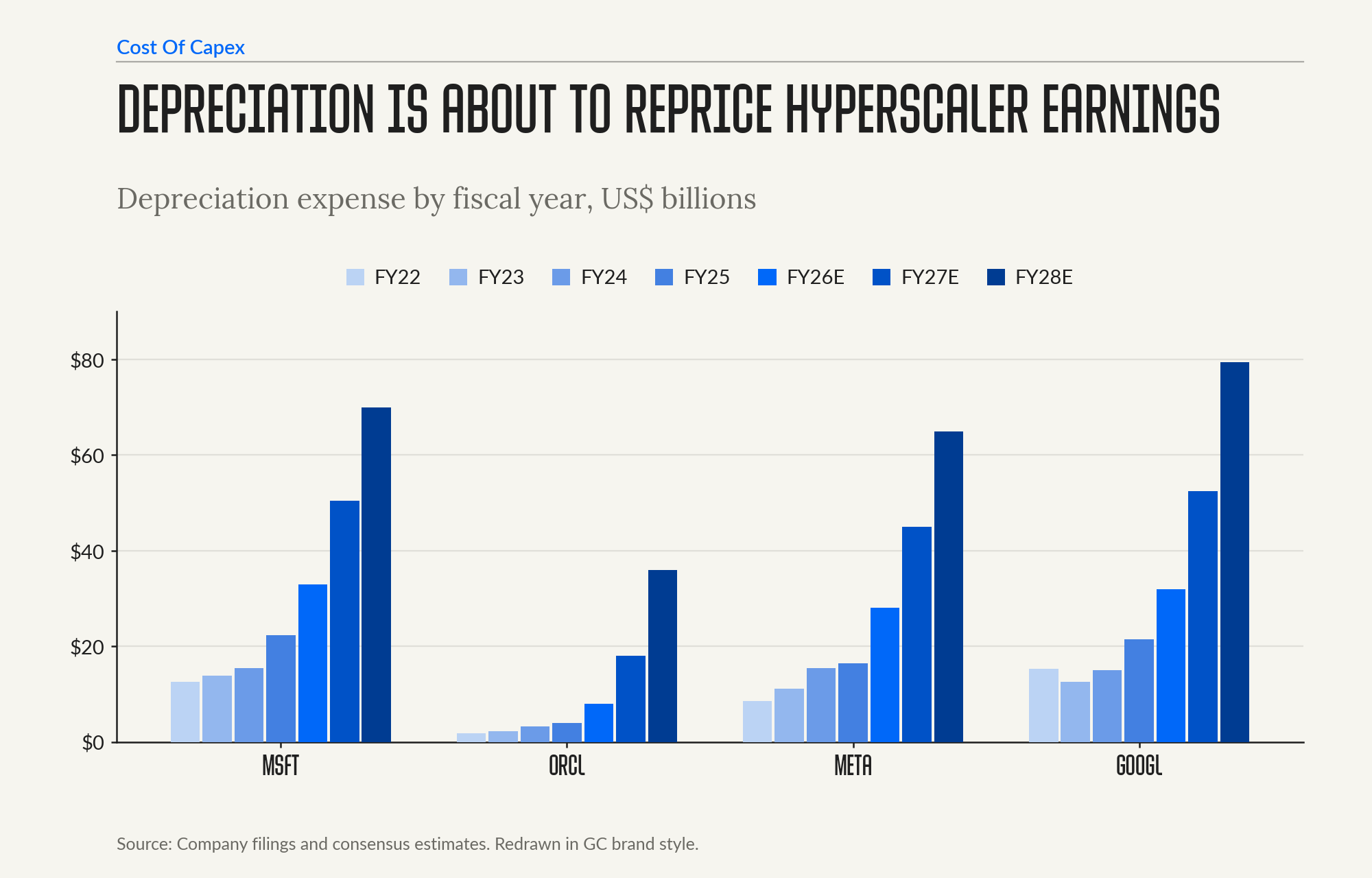
Compute pricing data would also enable investors to answer one of the critical questions facing this market: how should these GPUs be depreciated? This has become a hotly debated topic and one that impacts the value of these trillions of dollars of investment.
Additionally many investors won’t just want to utilize these markets for hedging, but speculation as well. Oil provides an interesting comparison here where the paper market volume is 28x global consumption. The trading firms have already indicated an interest in building out desks to trade this new commodity.
What is Needed
Before any risk management products can be created, the industry needs to agree on a common benchmark. There is no single price of compute or even a given GPU per hour price as a range of factors influence the price a customer pays for a given resource. For a benchmark to be valuable it needs to be sufficiently correlated with what the majority of customers actually spend on compute to reduce basis risk. This requires actual spend data and a level of homogeneity across the market for a given chip family. Benchmarks will likely start chip-denominated and may migrate toward workload or output-denominated units as the market matures. In conjunction with an established spot benchmark, this will create a forward curve that can be used for risk transfer across the industry and enable investors to more accurately price GPU depreciation.
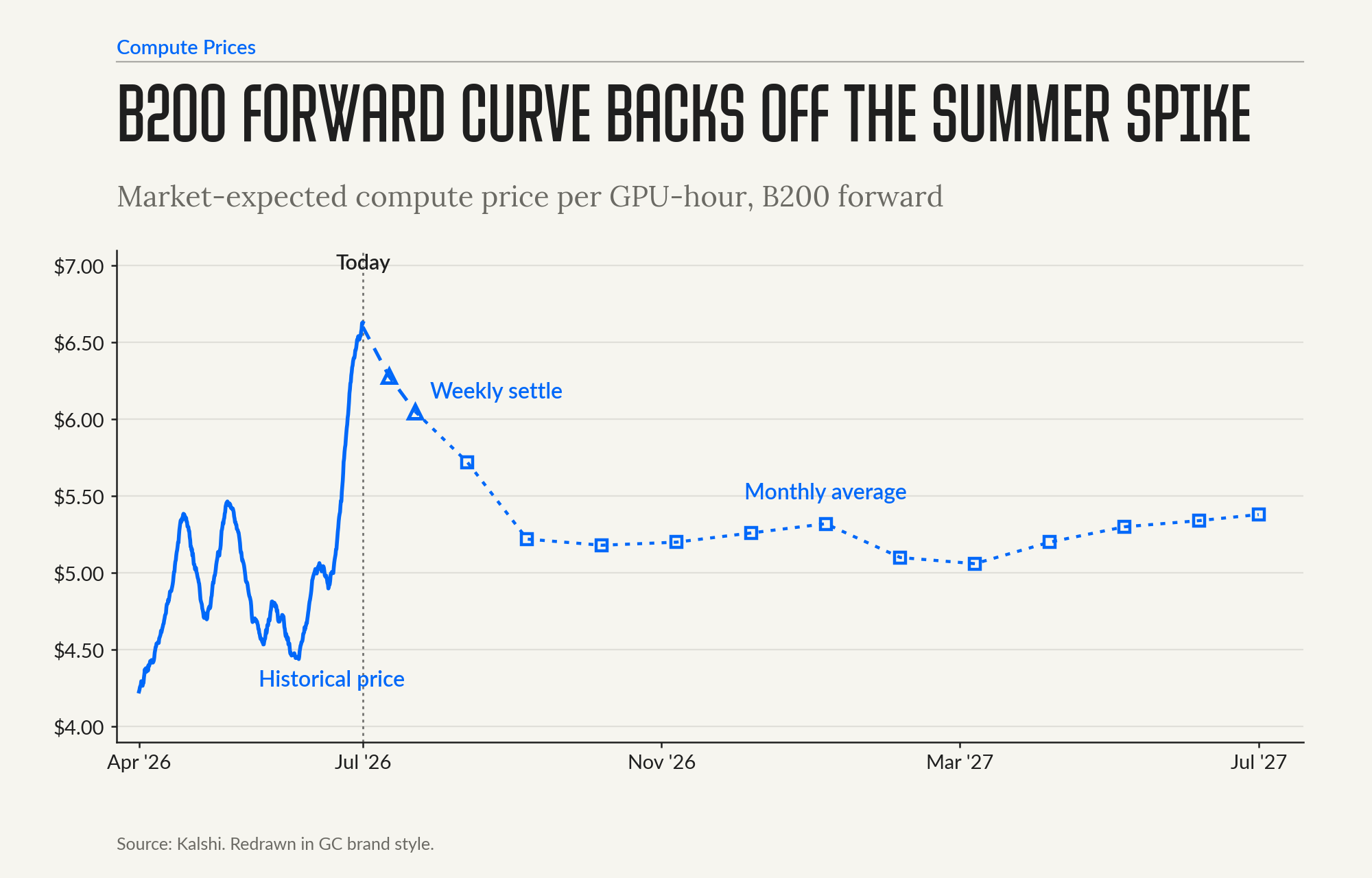
Once a benchmark has been established exchanges can list products and use the curve for OTC trades, creating a financial market for compute. The final piece is clearing and settlement, which turn these contracts into instruments lenders can rely on in hedging covenants.
Market Opportunity
The best corollary for this industry is the energy markets, and oil in particular. Oil was the dominant commodity of the past fifty years and accordingly a large financial market emerged to transfer risk. Following a crash in the price of oil in the early 80s, the NYMEX (later acquired by CME) launched the first futures tied to their domestic benchmark WTI. Eventually the international benchmark Brent (owned by S&P and traded on ICE) took share as its seaborne trade enabled it to better reflect global prices. Today ⅔ of all oil is traded on the Brent benchmark and it has driven massive outcomes both for the exchange and data provider:
ICE generates $3.2B of annualized revenue at 80% operating margin from its energy business which is roughly 60% oil and 40% natural gas
S&P generates $2B of annualized revenue at 49% operating margin from its monetization of the Brent benchmark and energy data sales. 40% of this revenue is directly tied to the trading fees. The rest is their subscription products around supply / demand fundamentals and forward curve data
As compute becomes the critical input into the economy over the coming decades, the data platforms and exchanges that support financialization should meet or exceed these levels on an accelerated timeline.
Oil traded for a century before WTI futures existed. Compute will not get that long: $7T of debt does not get raised without the ability to price and hedge it. New benchmarks, exchanges, and financing platforms are being created to unlock capital across the ecosystem, and we are excited to work with the entrepreneurs building them.
Sources: JPM Eye on the Market, SemiAnalysis, Bloomberg, & CapIQ
%201.svg)