%20(1).jpg)
In 1994, Peter Shor, a 35-year-old mathematician at Bell Labs, discovered a quantum algorithm for factoring large integers. A year later, Shor answered the objection his own algorithm had made urgent: that decoherence, the tendency of qubits to lose their fragile quantum states, made any such machine impossible to build. Shor's 1995 error-correcting code showed that quantum information could be protected after all, clearing the largest conceptual obstacle to replacing bits with qubits.
In 2026, the team behind Oratomic announced a breakthrough. Their paper proposing that Shor's algorithm is possible with as few as 10,000 reconfigurable atomic qubits made waves across the internet and in the scientific community. The challenge? Building the working computer. While the Oratomic team has built some of the most advanced neutral atom and error correction systems in the world, it’s the difference between small-scale aerodynamic tests and a rocket that actually launches to orbit, Oratomic CEO Dolev Bluvstein explains. “We're inventing this new field of engineering as we go, and we’ve structured the team and company directly for that,” he says.
General Catalyst is proud to back Oratomic in their mission. We believe Oratomic has the potential to reshape what is possible in computing and unlock advances in medicine, material science, energy, space exploration, and fields of study we have yet to imagine.
We believe Oratomic has the potential to reshape what is possible in computing and unlock advances in medicine, material science, energy, space exploration, and fields of study we have yet to imagine.
Many members of Oratomic’s founding team had no intention of becoming startup founders. They had built careers across Caltech, Harvard, Berkeley, Google, Amazon and other leading institutions, and were leaving established roles to pursue one of the hardest problems in physics: how to build a useful, fault-tolerant quantum computer.
While studying systems of cold atoms, members of the team helped develop a new approach to quantum computing built on reconfigurable atomic arrays. Their work led to the world’s first error-corrected quantum algorithms and was recognized with the 2024 Physics World Breakthrough of the Year.
The scientific progress increasingly pointed toward something larger. At Caltech, Bluvstein, Manuel Endres, and their colleagues brought together seven research groups around a common question: how quickly could they build a million-qubit, fault-tolerant quantum computer? Oratomic grew out of that effort. More broadly, there was a realization among the team that advances once thought decades away might be achievable much sooner.
Over the past few years, the team pioneered a new approach to quantum computing, one that has upended the field's estimates. The approach uses what they call reconfigurable atomic arrays: atoms are trapped in laser beams, the beams are moved around, and the atoms are zapped with lasers, which causes them to entangle. This turns out to make error correction significantly easier, for two reasons.
First, all the atoms are identical, and in error correction they all have to do the same thing. Error correction carries a lot of overhead, but because every atom is the same, a single global laser beam can illuminate all of them at once. That greatly simplifies controlling large numbers of qubits.
Second, traditional architectures generally assume that qubits sit in fixed positions and interact primarily with their nearest neighbors. In Oratomic’s system, atoms can be physically rearranged, allowing long-range connections between qubits. That changes the underlying geometry of the machine and makes much more efficient forms of error correction possible.
Together, these advances could dramatically reduce the complexity of building a useful fault-tolerant computer. Instead of individually controlling millions of qubits, simple parallel controls could operate thousands or tens of thousands at once, while the total number of physical qubits required could fall substantially.
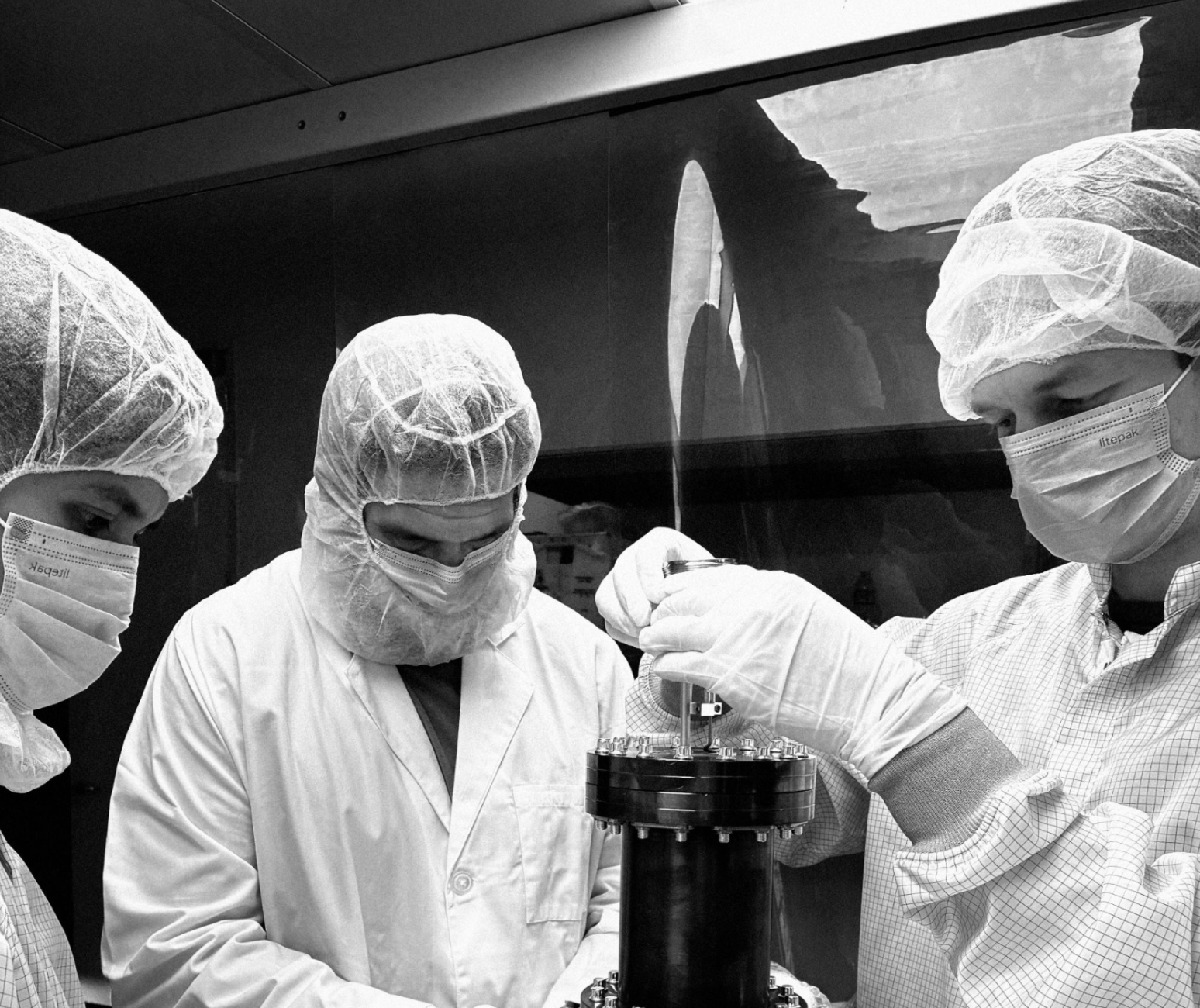
General Catalyst believes Oratomic has assembled an extraordinary concentration of talent. The team brings together leading researchers, scientists and engineers, including tenured academics and alumni of senior roles at other quantum companies. Many left established careers because they believed the scientific progress had created a rare opportunity to build something that previously seemed out of reach.
Bluvstein remembers the moment the pieces came together: “When we realized how all these things were going to collide, it was earth-shattering for us.”
That sense of possibility is shared across the company. The people who have joined Oratomic tend to be highly collaborative, technically ambitious and motivated by the same objective. “We all wanted to build the world’s first quantum computer,” Bluvstein says. “We were prepared to do whatever we needed to.”
The ambition extends well beyond a single machine. “When I think 100 years into the future, the world is quantum, information is quantum,” Bluvstein says. “I don't think the ultimate intelligence could be purely classical. It'll have to be at least in part quantum.” The potential impacts of quantum technology are quite hard to predict, according to the Oratomic team. “When you can make many of these useful quantum computers, they’ll also form the foundation of a quantum internet. And the quantum marketplace on the quantum internet will allow you to sell fun quantum states to your friends. We have no idea what’s going to happen.”
%201.svg)